

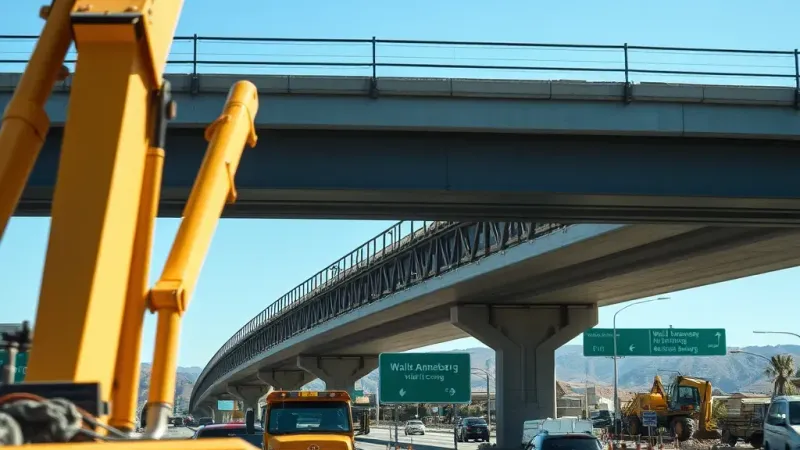
The Business Journal reported that the world's largest wildlife crossing spans U.S. 101 in Agoura Hills, with an official opening ceremony scheduled for Dec. 2. Daily traffic reaches approximately 300,000 vehicles on that stretch of the Southern California highway, creating a notorious physical divide across the natural landscape.
Wildlife Crossing Fund president Beth Pratt told The Business Journal, "Hear that? We’re listening to birdsong right now, on top of one of the busiest freeways in the U.S.!" Beth Pratt also told The Business Journal, "That makes my heart glad."
The massive infrastructure project measures 1,250 feet across two sections. It has been officially named the Wallis Annenberg Wildlife Crossing in honor of the late philanthropist. The financial backing required to build the structure was substantial, as the total budget ultimately reached $114 million, climbing past an initial cost estimated at $92 million. This funding pool included a major foundation donation of $25 million toward the total budget. Additionally, financial support came from a broad coalition, including contributions from 6,000 public members who wanted to see the project succeed. Leonardo DiCaprio also served as an early donor to the campaign, lending visibility to the fundraising efforts.
The public campaign gained immense emotional resonance and widespread recognition from the story of P-22, a famous cougar known as P-22 who became the campaign star. P-22 was unfortunately euthanized in 2022 after a suspected vehicle collision, highlighting the constant peril that large animals face from regional traffic. Reinforcing the urgency of the crossing, a UC Davis report found that at least 780 mountain lions are killed by vehicles annually across the state.
Already, wildlife is beginning to interact with the new structure. Motion-sensor cameras recently recorded a lone coyote crossing safely across the bridge, while separately, three juvenile coyotes were spotted playing beneath sound-dampening walls built as part of the crossing's design.
Various conservation and public agency professionals remain connected to the region's wildlife management and infrastructure. Jeff Sikich serves as a National Park Service biologist monitoring local fauna, Anthony Deascentis works as a field inspector for the California Department of Transportation overseeing road conditions, and Mari Galloway serves as the California program director for the Wildlands Network, participating in the broader network of environmental protection and advocacy across the state.