The Wallis Annenberg Wildlife Crossing, set to become the world’s largest, is barreling toward a Dec. 2 completion date over the 101 Freeway in Agoura Hills. However, a fierce winter storm could be the only thing to halt progress on the landmark project.
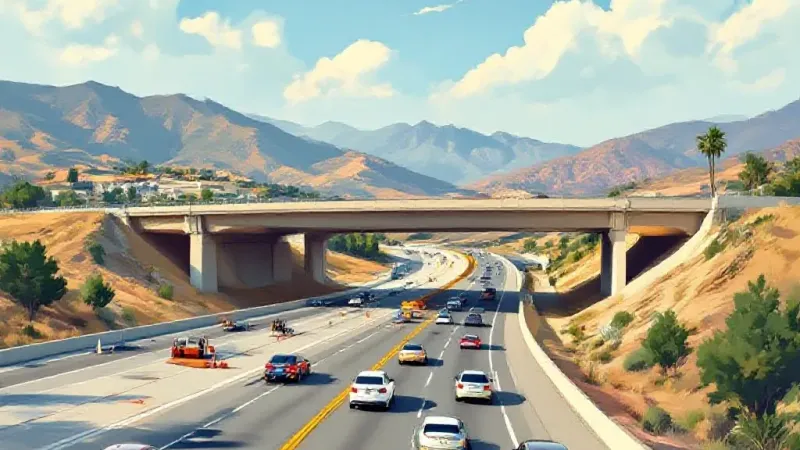
Already, a concrete bridge spans ten lanes of freeway traffic, topped with a landscape of 6,000 native plants. Crews recently finished another overpass for the adjacent Agoura Road. The remaining major task is to fill the extensive gap between the freeway, the road, and the northern land with millions of cubic feet of soil, creating a seamless pathway for wildlife.
The crossing's primary goal is to provide a crucial lifeline for mountain lions in the Santa Monica Mountains. These populations are isolated by development and traffic, leading to inbreeding among the big cats.
Beth Pratt, president of the Wildlife Crossing Fund and a prominent figure in the project, expressed cautious optimism about the weather. “We’re just hoping El Niño‘s on our side,” she said, noting that a super-sized version of the climate pattern is looming, potentially drenching Southern California. While some rain is manageable, flooding would force a work stoppage due to safety concerns. Robert Rock, lead landscape architect and principal designer for the crossing, explained that the area’s soil, rich in clay and silt, becomes dangerously slick when wet. Heavy rainfall also hinders the soil compaction process, where crews carefully layer and roll the soil.
Rock noted that it's challenging to compact a mud puddle. This isn't just a theoretical problem; historic rains in winter 2022-23 caused issues when water collected in a trench dug for the north wall’s concrete foundation, delaying soil compaction there. This previous incident pushed back the original late 2025 completion date.
In recent months, the project has drawn criticism from right-wing pundits and politicos over its delays and current $114 million price tag. A conservative think tank outlet called it a “bridge to nowhere” and a “jobs program for environmentalists,” with U.S. Transportation Secretary Sean Duffy comparing it to California’s high-speed rail project. Amid this surge of criticism, the December completion date was announced. Pratt admitted that the negative attention has been taxing, even making her hesitant to post about the crossing on social media. Despite the challenges, she confirmed that the team will “of course we’re still going to celebrate” when the project is finished.
The survival of the Santa Monica Mountains’ mountain lion population, which is listed as threatened, hangs in the balance. Seth Riley, wildlife branch chief for the Santa Monica Mountains National Recreation Area, highlighted the severity of the inbreeding issue, stating that 41% of documented matings since 2002 have been between close relatives. Just months ago, the National Park Service found a young collared male with a kinked tail, a clear sign of continued inbreeding problems. Riley warned that if reproduction is significantly affected, modeling predicts “essentially a 100% chance of extinction” within 50 years.
However, Riley believes it’s not too late. The crossing will enable the big cats to seek mates in the Simi Hills and beyond, introducing new genetic material into the isolated population. While genetic diversity won't increase overnight, the long-term outlook is positive.
Evidence of local wildlife already venturing near the construction zone has been captured. Jeff Sikich, a wildlife biologist at the Santa Monica Mountains National Recreation Area, reported that a trail camera near the south end of the crossing recently recorded coyotes, deer, and even a female lion with two large cubs, despite ongoing construction nearby. Furthermore, his team recently marked three kittens, the first litter from a 3½-year-old lion known as P-113, in the Simi Hills north of the crossing. Sikich anticipates that these kittens, once they mature and leave their mother, “might be — once they grow up and leave mom at roughly around 1½ — one of the first lions to actually use the wildlife crossing.”