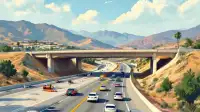

A wild coyote recently stepped onto a mound of dirt above the 101 Freeway in Agoura Hills, making it the first large mammal known to explore the Wallis Annenberg Wildlife Crossing as the project nears completion, the Los Angeles Times reported.
National Park Service wildlife biologist Jeff Sikich installed a camera near Agoura Road on Oct. 14 at the persistent request of Beth Pratt, president of the Wildlife Crossing Fund. Just days later, a black-and-white image captured just after 6 a.m. showed the coyote traveling up the slope, its eye reflecting brightly in the early morning light. The National Park Service officially released the image to the public this week.
While the coyote was unable to execute a full crossing—the soil was not yet high enough to connect the two overpasses spanning the freeway and an adjacent road—crews have since worked quickly to fill the gap. Though smaller creatures like Western fence lizards had already been seen on the site, the soil build-up now makes a complete trip across the structure possible for larger animals such as bobcats, coyotes, and mountain lions.
To prepare for increased animal activity, Sikich promptly installed six additional cameras directly on the structure. The remote monitoring plan will eventually feature more than 50 still photo cameras and four thermal video cameras. While footage will not stream live, researchers plan to share updates and images regularly with the public.
The roughly $114 million crossing is scheduled to open on Dec. 2, assuming severe winter weather does not cause unexpected delays. The project aims to restore connectivity for local wildlife whose habitats have been severely fragmented by urban development and busy highways.
For the isolated mountain lions residing in the Santa Monica Mountains, the structure represents a critical lifeline. Decades of isolation have forced close relatives to mate, leading to alarming signs of inbreeding such as physical deformities and low genetic diversity. Biologists emphasize that even a single new mountain lion crossing into the range from areas like the Simi Hills to breed could significantly improve the population's genetic health.
National Park Service researchers have been studying local carnivores in the Liberty Canyon area since 1996, when they first placed radio collars on bobcats and coyotes. Their tracking expanded to mountain lions in 2002. Moving forward, scientists will utilize GPS radio tracking alongside biologger devices implanted in deer and mountain lions. These devices will measure real-time physiological indicators, including heart rate, body temperature, and fat reserves, allowing researchers to evaluate how much stress animals experience when navigating the bridge over the highway.
Even prior to the coyote's appearance, wildlife activity around the site was high. Cameras placed near the southern terminus recorded multiple animals over a two-month period, including an uncollared mountain lion and another female lion traveling with two older kittens. With construction entering its final phase, conservationists hope the bridge will permanently reduce the threat of traffic collisions for the region's native species.