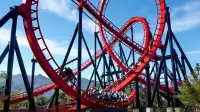

Six Flags Magic Mountain, often calling itself “The Thrill Capital of the World,” has shut down its X2 roller coaster, its long-standing “crown jewel,” following a state investigation and a series of lawsuits alleging rider injuries and deaths. The ride, known for spinning passengers 360 degrees in their seats, has been closed since July.
Cal/OSHA, the state agency responsible for inspecting amusement parks, confirmed an ongoing investigation into the ride but declined to offer further details or a timeline for its completion. This comes after multiple lawsuits claiming serious harm, including brain injuries and fatalities, linked to the X2.
Among the lawsuits is one filed by the family of Christopher Hawley, who was 22 when he died on June 24, 2022, a day after riding X2 with his brother. According to the complaint, which cited a coroner’s report, Hawley had trouble walking and lost consciousness shortly after getting off the ride. Doctors later found severe brain bleeding, attributed to head trauma from a “park ride accident.” The Hawley family settled their lawsuit against Magic Mountain last month for an undisclosed amount.
Christopher's mother, Anne Hawley, expressed her dismay upon hearing of more recent injuries. She stated, “It’s so beyond anything that should ever happen,” and later added, “If a ride injures somebody, close it down and find out why. If a ride kills somebody, don’t start it up again.”
Other court records detail similar tragic outcomes. Hilda Farias was 28 when she developed a brain bleed that led to her death in 2010 after riding X2. More recently, Sheila Katerelos claimed in a 2020 lawsuit that she suffered a traumatic brain injury from the ride, while Lucy Alvarez made a similar claim in 2021, alleging “great physical, mental and nervous pain and suffering.” Trials in the Katerelos and Alvarez cases are scheduled for next year.
CNN reported last month that X2 has been connected to over a dozen reports of serious injuries and hospitalizations in the past two decades, including the deaths of Hawley and Farias. The report also noted two cases in July where riders experienced brain hemorrhages requiring surgical intervention after riding X2.
The company that manufactured X2’s trains stated in court filings that the ride was tested after Christopher Hawley’s incident and found to be operating as intended. In a 2024 court filing, lawyers for the manufacturer cited a biomechanical engineering expert who concluded the ride could not have produced forces to cause traumatic brain injury to Katerelos, asserting that the headrest padding was sufficient for protection.
The X2 was revolutionary when it debuted, being the world's first roller coaster where seats spun 360 degrees, independently from the track. Riders are taken up a slope facing backward, then at the peak, their seats spin forward as they hurtle toward the ground headfirst. The ride's development, however, was not without its challenges. Its manufacturer, Arrow Dynamics, went bankrupt after the ride opened about six months late, according to a trade publication. Design flaws led to a closure for repairs months after its 2002 opening, and the trains were replaced with lighter ones in 2007.
Despite the recent reports, some roller coaster enthusiasts maintain confidence in the ride. Derek Perry, a spokesperson for the American Coaster Enthusiasts, said he has ridden X2 hundreds of times and believes it to be “perfectly safe.” Perry expressed hope for its reopening, stating, “I’ll be first in line.” Martin Lewison, an associate professor and Six Flags shareholder who has ridden over 2,600 coasters worldwide, echoed this sentiment, noting he wouldn't hesitate to ride X2 again. However, Lewison acknowledged it is an “extreme” and “aggressive” coaster, advising experienced riders to ride “defensively” to avoid hitting their head against the headrest.
Magic Mountain's focus on extreme thrills dates back decades, with rides like the Revolution in the 1970s, followed by Colossus, Viper, Batman- and Riddler-themed attractions, and Goliath, which featured a 235-foot free fall. The park has consistently aimed to keep pace with evolving amusement technology in a competitive industry.
Industry-wide concerns about the health effects of thrill rides emerged in the 2000s. A 2001 report in The Times mentioned several studies linking specific brain injuries to these rides, though it noted the data were limited. That same year, a Goliath rider died of a brain aneurysm, with the Los Angeles County Coroner concluding the ride did not cause the aneurysm but ruptured a pre-existing condition. Her family also sued.
While the X2 remains closed, Six Flags recently announced a new attraction, the Thrill Glider. Todd Martens, a theme park critic, described it as combining a motorbike-like seating with suspended coaster technology, where riders in “hoverbikes” will be suspended from the track in a prone, face-forward position, simulating flight.