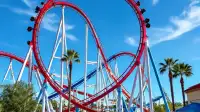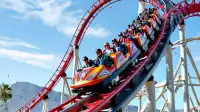
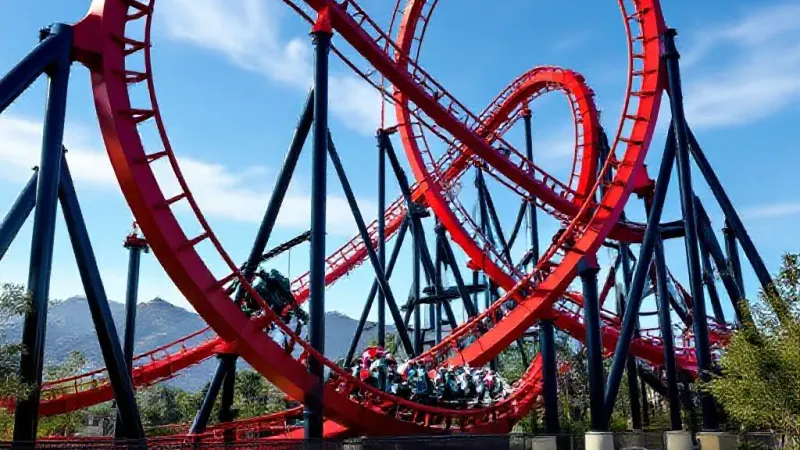
Six Flags Magic Mountain’s X2, long considered a flagship attraction at the Valencia theme park, was shut down in July as a state investigation into the roller coaster remains ongoing. Cal/OSHA, the state agency responsible for inspecting amusement parks, has not provided details on the investigation’s progress or completion timeline. This closure comes amid several lawsuits alleging serious injuries and deaths linked to the ride, which Magic Mountain once billed as "a [rite] of passage for the ultimate daredevil."
The X2 is unique in its design, being the first roller coaster globally to spin riders 360 degrees in their seats. Its seats are positioned on the side of the track, allowing riders' feet to dangle freely. The experience begins with riders facing backward as they ascend a slope, only for their seats to spin forward at the peak, sending them hurtling toward the ground headfirst. Derek Perry, a spokesperson for the American Coaster Enthusiasts organization, described it as a truly distinct experience: "There's no other coaster quite like it."
However, the ride's thrills have been overshadowed by tragedy and legal claims. Christopher Hawley, 22, died on June 23, 2022, shortly after riding X2 with his brother. According to the complaint filed by his family, he experienced difficulty walking and quickly lost consciousness, with doctors subsequently finding severe brain bleeding. A coroner’s report cited head trauma from a "park ride accident" as the cause of death. His mother, Anne Hawley, expressed profound distress upon hearing of further injuries this year, stating, "It's so beyond anything that should ever happen." The Hawley family settled their lawsuit against Magic Mountain last month for an undisclosed amount.
Other lawsuits make similar allegations. Hilda Farias, 28, developed a brain bleed and died in 2010 after riding X2, according to court records. Sheila Katerelos claimed a traumatic brain injury in 2020, and Lucy Alvarez alleged a traumatic brain injury in 2021, causing her "great physical, mental and nervous pain and suffering." The trials for Katerelos’ and Alvarez’s cases are set for next year. CNN reported last month that X2 has been linked to more than a dozen reports of serious injuries and hospitalizations over the past two decades, including the deaths of Hawley and Farias, and two brain hemorrhages in July that required surgical intervention. Six Flags has not responded to questions regarding the lawsuits or the reported history of injuries.
The company that manufactured the trains for X2 stated in court filings that the ride was tested after Christopher Hawley’s incident and was found to be operating as intended. In response to Katerelos' lawsuit, the manufacturer's lawyers cited a biomechanical engineering expert who concluded the ride could not have produced forces strong enough to cause a traumatic brain injury. They also asserted that the headrest padding was sufficient to protect riders.
Despite the recent reports, some roller coaster enthusiasts maintain confidence in the ride. Derek Perry, who has ridden X2 "several hundred times," believes it to be "perfectly safe" and hopes for its swift reopening. Martin Lewison, a seasoned enthusiast with over 2,600 coasters under his belt, and also a Six Flags shareholder, would ride X2 again. He acknowledged its "extreme" and "aggressive" nature, advising that experienced riders often ride "defensively" to avoid hitting their heads on the headrest. These enthusiasts emphasize that the reported injuries represent a small fraction compared to the thousands of riders who have experienced X2 without incident.
Anne Hawley, however, holds a different view. She believes, "If a ride injures somebody, close it down and find out why. If a ride kills somebody, don’t start it up again."
The X2 itself has had a bumpy past since its inception. Originally intended as a public relations success for its manufacturer, Arrow Dynamics, the ride opened about six months late, according to a trade publication, and its high costs contributed to the company’s bankruptcy. Months after its 2002 debut, X2 was temporarily closed to address design flaws. It faced another closure in 2007 for the replacement of its trains with lighter models.
Magic Mountain has historically prided itself on pushing the boundaries of thrill rides. In the 1970s, it introduced the Revolution with its full vertical loop, followed by Colossus, featuring a 100-foot drop. The 1990s saw the arrival of Viper, described as "the tallest, fastest-looping steel roller coaster in the world," alongside Batman and Riddler themed rides, and Goliath, known for its 235-foot free fall.
However, concerns about the health effects of extreme rides have been part of the broader industry conversation since the early 2000s. A 2001 report noted studies suggesting links between specific brain injuries and thrill rides, though data was limited at the time. That same year, a Goliath rider died of a brain aneurysm, which the Los Angeles County Coroner concluded was not caused by the ride, but rather its force ruptured a pre-existing condition.
Looking forward, Magic Mountain recently announced a new attraction, the Thrill Glider. Described by Times theme park critic Todd Martens, it will feature "hoverbikes" suspended from a track, designed to simulate flying with riders in a prone, face-forward position. This new ride continues the park's tradition of introducing innovative, high-thrill experiences.