
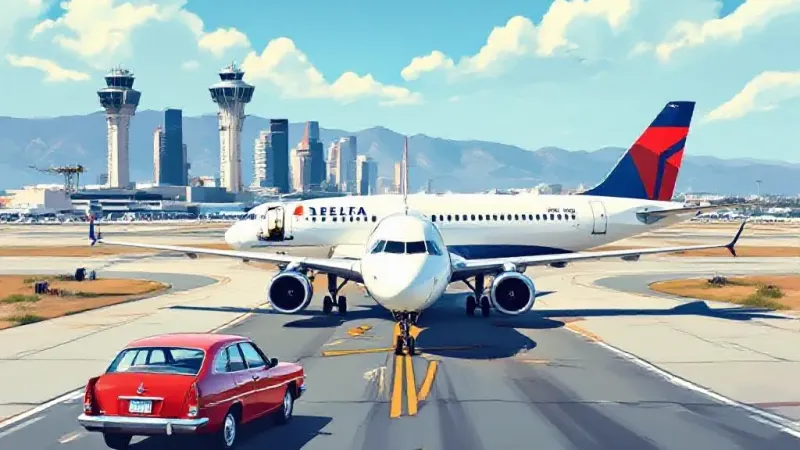
Los Angeles International Airport, a hub for travelers connecting across the globe, saw an unusual fender-bender on its taxiways Tuesday morning. A Delta Air Lines jet, moments before a long international flight, collided with an Air Canada aircraft. While the sight of two large planes making contact on the ground might raise an eyebrow, authorities confirmed that neither crew nor passengers reported any injuries from the incident.
The Federal Aviation Administration (FAA) detailed the sequence of events, stating that Delta Air Lines Flight 7 was actively taxiing for departure around 10:30 a.m. As it maneuvered along the busy airport surface, its left wing made contact, reportedly clipping the horizontal stabilizer—the crucial tail-end component that aids in an aircraft's stability during flight—of Air Canada Flight 785. This Delta flight, a significant international journey carrying 275 customers and 15 crew members, was confirmed by a Delta spokesperson to be en route to Haneda, Japan.
In contrast to the Delta jet's active taxiing, the Air Canada Flight 785 was not preparing for immediate departure under its own power. An Air Canada spokesperson informed NBC4 that their plane was being towed to its designated gate when the Delta aircraft contacted its tail. This distinction highlights two different modes of aircraft movement on the ground, creating a precise moment of contact.
Adding a firsthand perspective to the morning's events was Jayson Lowe, chief executive of Ascendant Financial Inc., who witnessed the collision from another flight at LAX. Lowe shared his observations on social media, emphasizing the distinct circumstances of the Air Canada plane. He noted that the Delta A350 managed to strike what he stressed was "a parked plane." Lowe further commented on the apparent lapse in situational awareness, suggesting that "somebody in that Delta cockpit lost spatial awareness near an object roughly the size of a condominium building with wings." It’s not every day an object of that scale becomes an unwitting obstacle on the tarmac.
Delta swiftly issued a statement regarding the incident. The airline confirmed its aircraft had "made contact" with an Air Canada plane while taxiing at Los Angeles International Airport. Reiterating their commitment to passenger well-being, the statement emphasized that "Nothing is more important than the safety of our customers and people," and offered an apology for the "experience and delay in their travels." For those 290 people on Delta Flight 7, and likely passengers and crew on the Air Canada flight, this meant an unexpected pause in their travel plans and the disruption that comes with any on-tarmac incident.
The Federal Aviation Administration has since initiated an investigation into the collision. This standard procedure will involve reviewing communications, flight data, and ground operations protocols to determine the full circumstances of what occurred on the LAX taxiway, ensuring future operations continue as smoothly as possible, ideally without any impromptu airplane-on-airplane contact.