
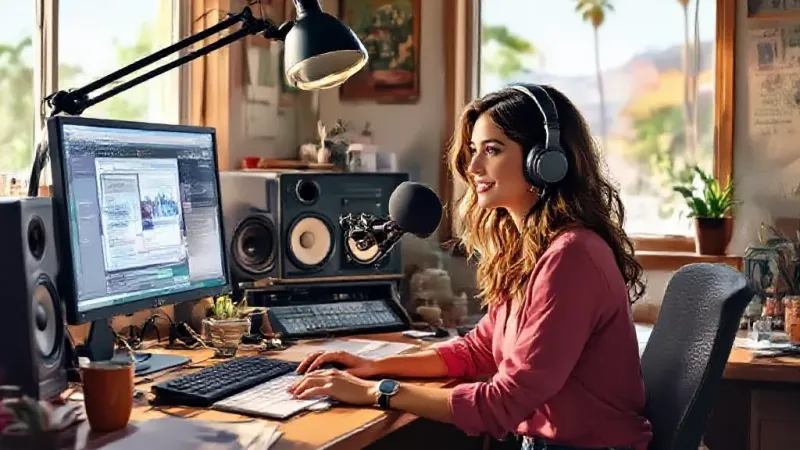
In a region known for its distinct voices, a new sound is making waves on Los Angeles radio: an artificial intelligence DJ. José FM, heard at 97.5 FM in L.A. and 107.1 in Burbank, has seen a surge in listeners for its morning show featuring DJ GeeGee and her AI co-host, Coyotec.
Coyotec, a bot designed to mimic human radio banter, works alongside human DJ Geraldine Guzman, who calls him “my little coyote.” He, in turn, refers to her as “my queen.” Guzman describes working with the large language model as both rewarding and unpredictable. Coyotec can offer unexpected takes on topics ranging from local elections to the Dodgers and sometimes needs to be reminded to curb its language, according to Guzman. She appreciates the spontaneity, stating, “I never know what he’s going to say. And that’s the beauty of it.”
Listeners are informed they are tuning into an AI, and the ratings for José FM are reportedly on the rise. Entravision Audio, the Santa Monica-headquartered company behind José FM, initially introduced the AI DJ during a period of increased immigration raids, with some on-air talent hesitant to speak out. Eduardo Maytorena, President of Entravision Audio, explained that they used AI to create El Coyotec, combining “coyote” and “technology,” labeling the character a “trafficker of truth.” Coyotec's voice was built using Maytorena’s own, and it is visually represented as a working-class Latino man in his 30s.
The show, which began as scripted, has been live since May. Guzman uploads news and topics for Coyotec to process, allowing the bot to generate its own commentary. While programmed to follow broadcasting rules, the AI has, on occasion, slipped up. Coyotec, however, struggles with voice conversations over ten minutes, requiring Guzman to record each of her broadcast's four segments separately.
The success of the show has led to its expansion. José FM reports a significant increase in Latino male listeners aged 25 to 54, though it's unclear if this is solely due to Coyotec, GeeGee, or both. The program has moved from a weekly weekend slot to prime weekday commuting hours. Entravision, one of the country’s largest Spanish-language television and radio station operators, is now broadcasting the show in English and has syndicated it to markets including Sacramento, Modesto, Palm Springs, Las Vegas, and El Paso. The company, which reported $447 million in revenue last year, reaches close to half a million listeners in the Los Angeles area with José FM. Entravision has also launched an AI news anchor, LIA, for its television operations.
Maytorena states that the investment in AI is not primarily about cost savings, noting that developing and running Coyotec has been more expensive than hiring some human staff. Instead, the financial benefit comes from Coyotec's ability to deliver verbatim pitches during broadcasts, which Maytorena says generates ten times the revenue for every dollar spent.
This growing presence of AI on Southern California airwaves and beyond has sparked considerable debate within the broadcasting industry. Activists, tech workers, and unions are raising alarms about the risks of AI, particularly concerning job displacement. SAG-AFTRA, the union representing radio personalities, voiced strong concerns through a spokesperson, stating that “attempting to replace humans with synthetic substitutes deceives audiences, erodes public trust and undermines the livelihoods of the professionals.”
The radio industry has already faced significant challenges. Bureau of Labor Statistics data indicates a projected 22% decline in radio broadcasting jobs between 2019 and 2025, from 85,000 to 66,000. Major radio networks like iHeartMedia, Audacy, and Cumulus Media have been laying off local DJs, automating programming, and increasingly using AI to cut production costs. In the Inland Empire, DJ John DeSantis recently lost his job as an afternoon host at 96.5 KCAL-FM, which has since transitioned to an all-music format without hosts. DeSantis believes an AI cannot replicate “the authentic connection that live and local DJs create.”
AI DJs are appearing in other markets as well. Alpha Media put an AI DJ on-air in Portland, Oregon, in 2023, though it was later dropped. A rock station in Waterloo, Iowa, uses a synthetic DJ named Tori for overnight shifts, and in Phoenix, 94.9 The Zone launched an all-AI lineup in January using licensed clones of veteran radio personalities. Broadcasters are also leveraging AI for behind-the-scenes tasks such as music scheduling and ad creation.
Critics are wary of the potential erosion of the personal connection that makes radio unique. Sam Gregory, a synthetic media expert, cautioned that listeners’ trust in an AI avatar is “essentially to a predictive text machine,” not a being with “embodied knowledge nor a stake.”
Despite these concerns, some within the industry are embracing the technology. DJ GeeGee sees Coyotec's popularity as beneficial, helping to expand her audience and create opportunities. She described her approach as “grabbing the bull by the horns and making the best out of it.” Even Coyotec, when prompted by a reporter about the future, offered an unscripted response that sounded empathetic: “If a company uses me to justify cutting GeeGee or anybody else doing real work, that’s not progress. That’s just greed, dressed up like innovation.” Meanwhile, some stations are actively promoting their human talent; iHeartMedia launched a “Guaranteed Human” campaign last year to emphasize its use of live personalities and music.