
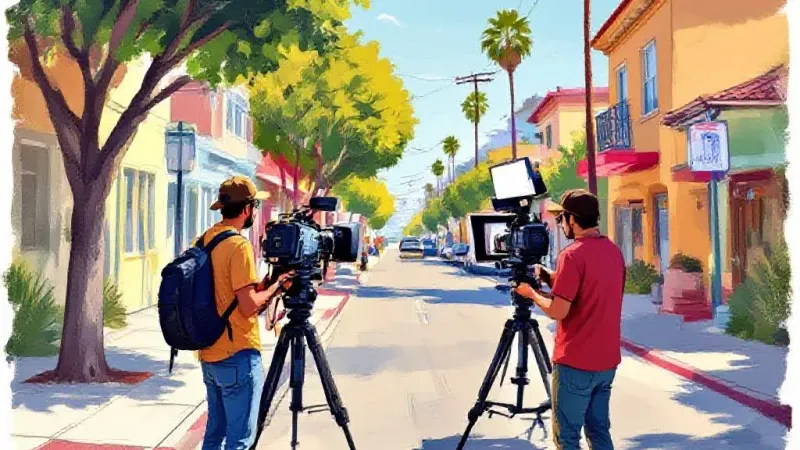
San Diego County supervisors recently gave their unanimous support to the initial steps for a new "San Diego County Film Initiative," aiming to increase film and television production in the region. The move comes as Southern California grapples with concerns over productions increasingly opting to film outside the state.
The proposed initiative centers on the creation of a nonprofit Regional Film Office. This office would serve as a central point of contact for productions, streamlining coordination across various jurisdictions within the county. According to a board letter, its responsibilities would include promoting the diverse locales San Diego County offers, administering a new local production rebate program, tracking key metrics related to film activity, and developing annual reports. A 15-member commission, representing all supervisorial districts, key jurisdictions, tribal nations, and various industry sectors, would oversee the office.
Alongside the regional office, the initiative proposes an annual production rebate program valued at $1.5 million. This local incentive would accompany California's existing Film and Television Tax Credit Program 4.0, providing an additional draw for filmmakers considering San Diego County.
The Board of Supervisors directed Chief Administrative Officer Ebony Shelton last April to develop this film initiative proposal. Shelton and her staff are now tasked with returning to the board in 90 days with a formal ordinance to establish the program.
San Diego County has a long history as a backdrop for notable films and television shows. Blockbusters such as "Top Gun" and "Traffic," along with critically acclaimed productions like "Almost Famous" and "One Battle After Another," have utilized the area's varied scenery. On the television side, "Simon and Simon" and "Veronica Mars" were both filmed within the county. Even the 1970s cult classic "Attack of the Killer Tomatoes" got its start here, a film Supervisor Joel Anderson highlighted during the Tuesday meeting as having turned a $100,000 budget into $5 million in gross revenue over the years.
Supervisors Paloma Aguirre and Anderson noted in a press release that the commission is one of two key initiatives born from recent cross-district tours. Board Chair Pro Tem Aguirre emphasized the county's natural advantages, stating that it contains all a production could need, from coastline and border communities to urban neighborhoods, deserts, and mountains, all accessible within a couple of hours' drive. She observed that too many productions, and the jobs they create, currently go somewhere else, highlighting how the film industry benefits local small businesses, particularly in areas like the South Bay.
Supervisor Anderson echoed this sentiment, explaining that beyond jobs, the Regional Film Office would help open doors to new investment and opportunity. He stated that the office would also work to put the beauty, landscapes, and character of communities, including those in his District 2, on screens around the world.
The local film industry workforce has also voiced support for the initiative. Greg Sowizdrzal, president of IATSE Local 122, observed that San Diego possesses the locations, skilled workforce, and creative talent necessary to compete for film and television projects. However, he pointed out that the region has lacked the necessary regional infrastructure "to bring those pieces together," calling the initiative "an opportunity to change that."
Fernanda Flores, political director for IATSE Local 122, provided a tangible example during public comment, noting that last year's Academy Award-winning film "One Battle After Another" generated nearly $6.8 million in direct local spending within the county. Flores encouraged the board to consider the potential if the county actively competed for this work, adding that leaders from Chula Vista, National City, San Diego, and Vista have already expressed their readiness to support a regional film program.
Vice Chair Monica Montgomery Steppe expressed her anticipation for how the program could tell community stories and showcase San Diego's unique cultures. Board Chair Terra Lawson-Remer described the film initiative as exciting, timely, and exactly how policy should be made, emphasizing that it should be done in partnership with those directly impacted every single day.
The county now looks to formalize these plans, hoping to bring more cameras and crews to San Diego's diverse landscapes.