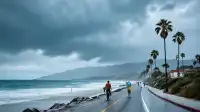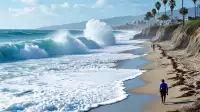

Southern California’s coastline, which has already seen its share of tropical storm impacts this year, is on alert as Hurricane Polo rapidly intensified off Mexico, reaching Category 5 status on Tuesday afternoon.
Forecasters with the National Hurricane Center issued an advisory Tuesday afternoon warning that Polo, which is moving northwestward, is expected to remain "extremely dangerous" for the next several days. The storm continues to strengthen in a "very conductive environment" characterized by low wind, extremely warm ocean waters, and abundant moisture, with maximum winds blasting at 180 mph. Polo is the 16th named storm to form in the eastern Pacific this year.
For residents along the southwestern coast of Mexico, Polo is expected to bring heavy rainfall through Thursday, with a risk of life-threatening flooding and mudslides, particularly in steep terrain. Tropical storm warnings are in effect for portions of that region.
For Southern California, the effects will be considerably less drastic. However, the storm could pull tropical moisture into the region, depending on upper-level atmospheric patterns. Bryan Lewis, a meteorologist with the National Weather Service in Oxnard, noted on Monday that such moisture could be a factor. By Tuesday afternoon, Lewis indicated a 5% chance of rain for Los Angeles County, contingent on the hurricane's exact path.
The greater concern for Southern California, according to Lewis, is the potential for high surf and high tides to coincide next Monday and Tuesday, which could lead to coastal flooding. The National Weather Service in Los Angeles also forecasted elevated surf and strong rip currents at beaches this weekend and into next week, a result of multiple southerly swells converging.
Lewis pointed out that "after almost an entire summer of southern swell after southern swell, there could be some issues for those vulnerable coastlines." This year, several Southern California communities, including Laguna Beach, Dana Point, and Carlsbad, have already declared local emergencies due to coastal erosion and sand loss caused by powerful tropical storms from the Pacific.
This activity is consistent with an El Niño pattern, which typically brings an unusually active hurricane season to the eastern Pacific and often leads to heavy winter rainfall in Southern California. The current El Niño is predicted to be the strongest in at least a generation. In anticipation of this winter's storms, Governor Gavin Newsom has already declared a statewide emergency, citing concerns that the weather pattern could bring high surf and high-impact storms across the state.