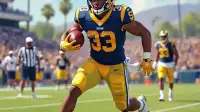
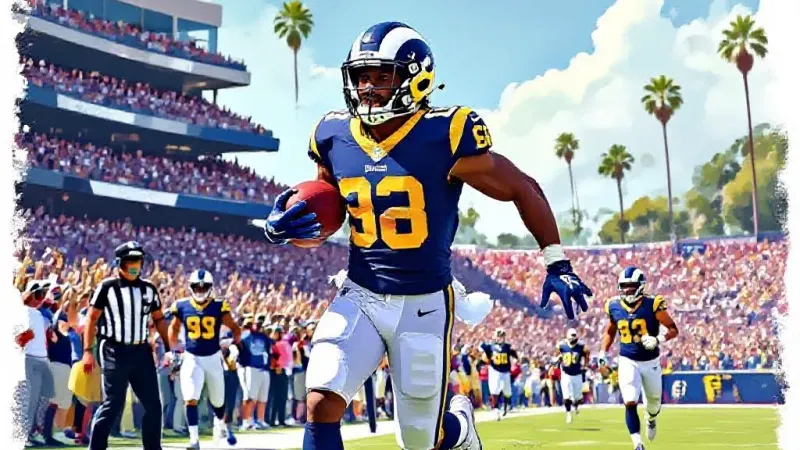
The Los Angeles Rams secured a hard-fought 24-20 victory against the Philadelphia Eagles in Week 4, pulling off a significant comeback to move to a 2-2 record for the season. Despite the Eagles holding what at times felt like an insurmountable lead, the Rams orchestrated a late rally, capped by a 99-yard drive that saw running back Kyren Williams score his second touchdown of the day.
Williams emerged as a central figure in the Rams’ offense, delivering a performance described as potentially his best stretch of play as a veteran running back. He carried the ball 16 times for 80 yards, averaging 5.0 yards per carry, and found the end zone twice. Beyond his rushing, Williams was heavily involved in the passing game, targeted 13 times by Matthew Stafford and hauling in 10 receptions for 67 yards. This complete effort firmly established him as the focal point of the team’s attack.
While the offense worked to find its rhythm, the Rams’ defense played a crucial role in keeping the team within striking distance. They consistently held the line, making key stops even when the offense put them in difficult positions. A critical fourth-down stop in the red zone late in the game provided the offense with the opportunity for their decisive 99-yard drive. Cornerback Josh Wallace also earned praise for his quick turnaround in performance, fitting seamlessly into the coverage scheme after a challenging previous week, aided by the Eagles being short-handed in terms of pass catchers.
Receiver Puka Nacua quietly amassed 125 yards through the air, catching nine of his 12 targets and proving an efficient component of the passing game. Despite managing a soft tissue injury, Nacua largely looked like his usual self, a positive sign for the Rams. However, the overall passing game struggled at times, with the team dropping five passes throughout the game, and receivers sharing blame for execution failures. Matthew Stafford's performance was also described as not sharp, playing better in the late fourth quarter but not delivering a consistent winning performance.
The struggles extended to specific offensive connections. Veteran receiver Adams had at least two drops, including a potential touchdown on a deep throw from Stafford. The inability of Stafford and Adams to connect on deep passes has been noted as a "troubling and continuing trend" through the first four weeks of the season, indicating ongoing coordination issues between the duo.
Special teams also faced challenges during the game. The Eagles averaged 19.7 return yards on three punts, a figure largely attributed to Britain Covey, a return man the Rams had waived last year in favor of a player since released. Kicker Harrison Mevis also missed a 48-yard field goal, though he did connect on a 40-yard attempt. This performance highlighted the team's reluctance to attempt longer field goals, rarely letting him kick from beyond 45 yards out.
Stafford's overall play was a point of concern, with two interceptions directly leading to 10 points for the Eagles. The Rams’ offense managed only 10 points in the first half and went scoreless in the third quarter, saving their most effective work for the final five minutes of the game. This pattern reflects a challenge in playing 'complimentary football,' where all three phases of the team — offense, defense, and special teams — work in coordination.
In the backfield, Williams' 29 opportunities (rushes and targets) significantly overshadowed Blake Corum's seven. Corum, once part of a more balanced backfield, has seen his role diminish, doing little to prompt the coaching staff to question the current rotation. However, the momentum built during the game’s final two drives, particularly the decisive 99-yard march, offers hope that the team can carry this renewed energy into future matchups.