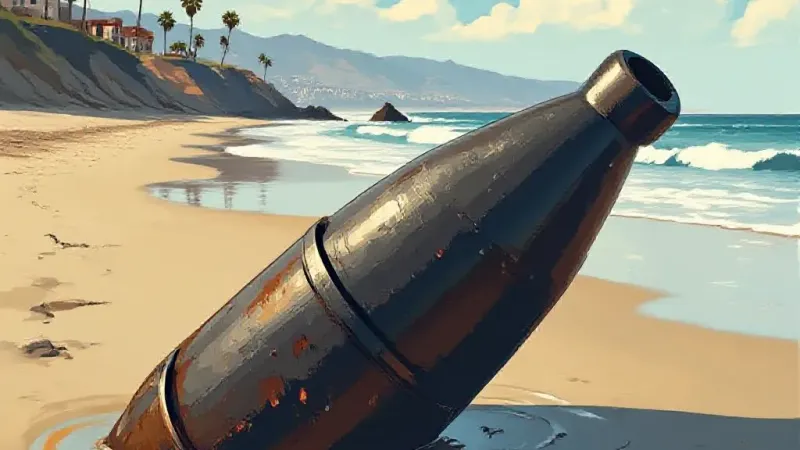
Southern California's beaches have seen more than just high surf and sand erosion from recent El Niño-driven storms; they've also become a temporary resting place for some truly unexpected items, including military ordnance. Ventura County officials recently responded to a 'bomb-like' marine marker found on a local beach, prompting a significant safety alert.
The item was identified as a Navy MK25 phosphorus location marker, a device designed to create a visible smoke and flame signal to pinpoint objects or people in the water. While its exact origin or the specific beach of its discovery remain unclear, the Ventura County Sheriff’s bomb squad became involved.
Adding to the puzzle, the Orange County Bomb Squad noted in an Instagram comment that they have also encountered similar devices washing up in recent weeks, suggesting a wider pattern linked to the powerful storms. A concerned citizen, out of fear for public safety, reportedly took the marker home before contacting law enforcement.
This well-intentioned act, however, triggered a response from both the Sheriff’s Bomb Squad and a Navy explosive ordnance disposal unit from Point Mugu, who converged on the Ojai residence where the device was taken. Officials emphasized that marine markers, even if wet or expended, pose significant dangers. Residual phosphorus, once exposed to air and drying, can spontaneously reignite or explode when moved, burning at temperatures up to 3,000 degrees and releasing toxic fumes. Authorities strongly advise that if anyone encounters an item resembling a bomb or military equipment, they should leave it in place, evacuate the area, and immediately call 911.
This isn't the only time Southern California's shifting sands have revealed military history. In July, a Super Bazooka round from the 1950s era washed up at Mugu State Beach Tower 14 within Point Mugu State Park. Sheriff officials noted that this stretch of sand served as a military training facility before becoming a public beach, making such discoveries more common as tides and erosion shift. The round, still containing live explosives, was deemed too dangerous to transport and required the beach and a section of Pacific Coast Highway to be shut down for its disposal in place.
Beyond military relics, the latest ocean conditions have brought other notable changes. In August, sand erosion near the entrance of Newport Harbor exposed decades-old jetties, originally built to protect oceanfront homes. Marine life has also made headlines, with a hammerhead shark, typically found in warmer waters, spotted circling near Malibu Pier. Even more remarkably, two olive ridley sea turtles, usually residents of tropical oceans, made a historic first appearance in Southern California in September, laying eggs on beaches in Seal Beach and Huntington Beach.