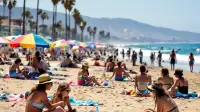

Southern California residents endured a week of scorching, record-setting heat, complete with sporadic power outages and a forecast that sees temperatures dip before potentially returning to a muggy normal.
Wednesday saw triple-digit temperatures shatter previous records across the Southland. Woodland Hills hit 111 degrees, surpassing its 1981 record of 109, while Lancaster reached 107, beating a 1950 record of 106. Even coastal-adjacent areas felt the heat, with the Camarillo Airport recording 90 degrees and the National Weather Service's Oxnard station hitting 92, both breaking 2015 records. Downtown Los Angeles tied its 1981 record at 98 degrees.
After a slight reprieve on Thursday due to increased cloud cover, temperatures were expected to rebound Friday, with forecasters warning of a high risk for heat illness. Predicted highs included 111 degrees in Canoga Park, 107 in Santa Clarita, and 100 in downtown L.A.
Amid the heat, thousands of residents experienced power outages. The Eastsider reported up to 3,000 residents in Echo Park and Westlake lost power on Wednesday, a number Los Angeles Department of Water and Power spokesperson Sandra Robles would not confirm, but she stated about 800 customers in those neighborhoods remained without power Wednesday evening. By Thursday afternoon, about 60 Echo Park customers were still affected. Robles stated the cause was under investigation and it wasn't immediately clear if the heat wave played a role. Moreno Valley residents also sweltered through outages on Tuesday, and a scheduled maintenance outage in Huntington Park during extreme heat caused frustration.
Relief, however, is on the way. The National Weather Service anticipates a "steady cooling trend" starting no later than Saturday and continuing through Monday, with temperatures decreasing by about 5 degrees daily. By early next week, highs should be near normal for early September, or even a few degrees below.
The week's high temperatures, which were unusual after what the National Weather Service described as a "pretty typical" summer, were partly attributed to El Niño. Carol Ciliberti, a meteorologist with the National Weather Service in Oxnard, noted that El Niño contributed to warmer coastal waters. This, combined with intense inland heat, resulted in higher coastal temperatures, robbing the usual marine layer of its cooling power.
While the heat wave breaks, more mugginess may follow. Moisture from the remnants of Tropical Storm Iselle caused some scattered showers and thunderstorms on Thursday and Friday, making roads slippery in parts of L.A. and San Luis Obispo counties. Looking ahead, another tropical system from Mexico could bring "additional moisture and shower chances locally" by the middle of next week.