

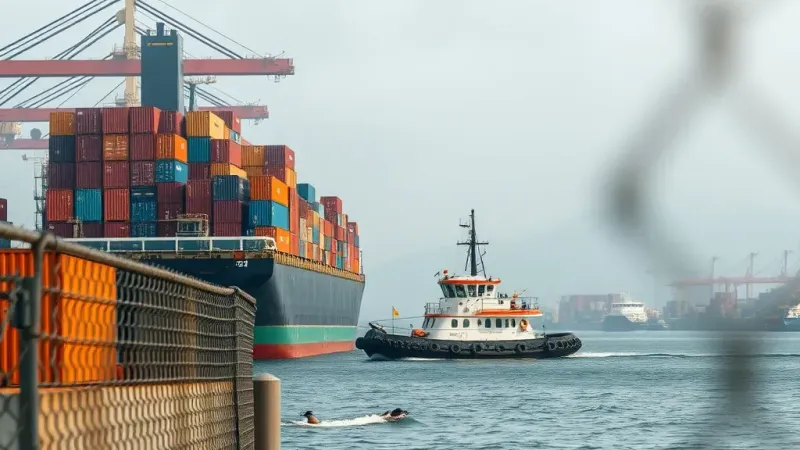
The Port of Long Beach reached record-low emissions per container in the year two thousand twenty-five, according to a local news report. During this same annual reporting period, the Port of Long Beach handled a massive volume of cargo, recording nearly nine point nine million twenty-foot equivalent units processed through its facilities.
When comparing the recent twelve-month period to the prior year, data compiled by a local news report shows that environmental metrics improved across multiple categories at the Port of Long Beach. Specifically, diesel particulate matter dropped seven percent from two thousand twenty-four to two thousand twenty-five at the Port of Long Beach. Nitrogen oxides declined nine percent between two thousand twenty-four and two thousand twenty-five. Additionally, sulfur oxides fell nine percent from two thousand twenty-four to two thousand twenty-five, and greenhouse gases decreased six percent from two thousand twenty-four to two thousand twenty-five.
Looking at a broader timeline stretching back several years, a local news report details how the Port of Long Beach has managed emissions alongside increased operational activity since two thousand seventeen. Over this multi-year span, diesel particulate matter fell thirteen percent since two thousand seventeen at the Port of Long Beach. Nitrogen oxides dropped thirty-four percent since two thousand seventeen, and sulfur oxides declined twenty-nine percent since two thousand seventeen. However, greenhouse-gas emissions rose nine percent since two thousand seventeen at the Port of Long Beach. This came alongside substantial growth in overall cargo handling, as container throughput grew thirty-one percent since two thousand seventeen.
Operational details released regarding the Port of Long Beach fleet and equipment shed light on the infrastructure driving these trends, as detailed by a local news report. Ninety-five percent of drayage trucks operating at the Port of Long Beach were model year two thousand fourteen or newer. Meanwhile, a smaller portion of the drayage fleet reached the milestone of being zero-emission, specifically standing at two percent of the drayage fleet.
Additional equipment and vessel metrics at the Port of Long Beach indicate that twenty-one percent of vessel calls used Tier III engines. Furthermore, twenty-one percent of cargo-handling equipment was zero-emission, and shore power and emissions-control barge usage increased eleven percent.
Steven Neal spoke to a local news report regarding these environmental and operational updates from the Port of Long Beach, offering perspective on balancing commerce and ecology. "These findings confirm one of our foundational principles — that it’s possible to serve as a vibrant and strong jobs engine for the nation while protecting the environment," Steven Neal told a local news report.
Emphasizing the ongoing mission of the port authority, Steven Neal added further remarks to a local news report. "We are incredibly proud of our achievements and will continue our unwavering commitment to cutting emissions for our community," Steven Neal told a local news report.