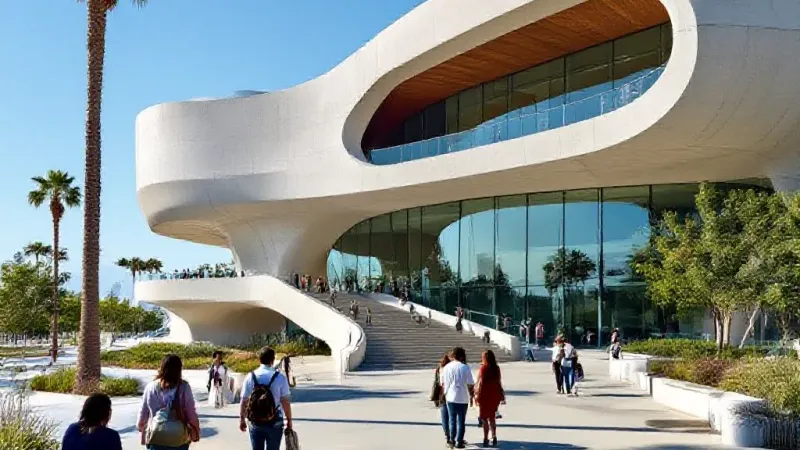
The $1-billion Lucas Museum of Narrative Art is set to open its doors in Exposition Park on September 22, but not without some last-minute legal drama. An electrical contractor has filed a $1.9-million lawsuit, one of four recently brought against the museum, alleging it bypassed mandates typically required for public works projects.
J.E. Snyder Electric, a subcontractor on the project, claims the museum, along with its prime contractor Hathaway Dinwiddie Construction Co. and first-tier subcontractor Siemens Industry, Inc., “actively promoted, contracted, and labeled the construction as a ‘private, non-profit development.’” This classification, Snyder Electric argues, allowed them to avoid rigorous administrative, registration, and bonding mandates of California Public Contract Code, Civil Code, and Labor Code. Specifically, the lawsuit contends the museum should have obtained a payment bond, a form of collateral required for public works, and registered the project with the California Department of Industrial Relations.
The core of the dispute revolves around the museum's 99-year lease with the state, which carries an annual rate of just $30. Snyder Electric’s attorney, Christopher Hook, stated, “We contend this rent concession makes the project a public works,” citing the California Labor Code. The lawsuit asserts that the project is, and always was, a “public work” because it’s “paid for in part out of public funds, which explicitly includes the transfer of public assets for less than fair market value and the lease of public land for nominal or below-market rent.” John Snyder, co-founder of Snyder Electric, noted that his company has taken out loans to cover interest because of alleged unpaid bills from Siemens.
The Lucas Museum’s attorney, Orin Snyder, counters that the museum represents one of the largest private cultural gifts in American history, entirely funded by George Lucas and his wife, Mellody Hobson, with no public funds or debt. He called the claim that it’s a public work “a fiction, manufactured for leverage in a routine payment dispute by a subcontractor who has no direct contract with the Museum.” The museum’s lease with the city and state specifies it’s a privately funded project, with rent being part of a larger exchange providing public benefits, including annual payments that rose to $2.1 million during periods of construction, as well as upgrades to a soccer field, new parking areas, renovations at Jesse Brewer Park, and the creation of 11 acres of public park space.
This isn't the only legal challenge. Hathaway Dinwiddie, the prime contractor, has also sued the Lucas Museum for alleged breach of contract for payment “in excess of $35,000.” Three additional contractor lawsuits seek between $272,000 and $439,000. Siemens and Hathaway Dinwiddie declined to comment on the ongoing litigation.
Project delays, initially caused by the COVID-19 pandemic, also play a role in the contractors' claims. The museum, initially slated for a 2021 opening, saw its timeline repeatedly pushed back, and Snyder Electric alleges unpaid bills began to accrue during these extensions.
The practice of offering token land deals to attract projects considered for the public good is not new in Los Angeles. City officials once offered billionaire philanthropist Eli Broad a $1-per-year lease for his eponymous museum downtown. After public outcry, Broad ultimately paid $7.7 million for the 99-year lease. Exposition Park’s Natural History Museum also operates with a $1-per-year lease, as a public-private partnership with Los Angeles County. Former L.A. Mayor Eric Garcetti, who was in office when the Lucas Museum deal was struck, stated that L.A. aimed for the “most frictionless route” to bring the museum, saying, “Public land should be used for a public good.”
The question of whether the $30 annual lease transforms a $1-billion private gift into a public work will now be for the court to decide, adding a layer of legal complexity to the opening of a major new cultural institution in Southern California.