
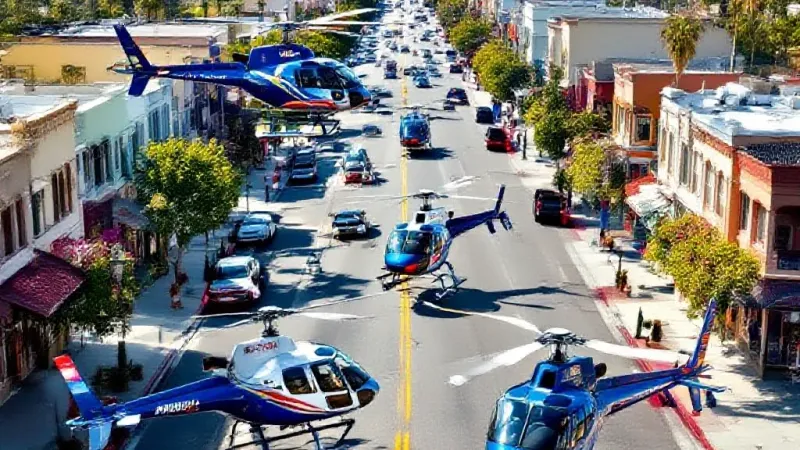
Viewers across Southern California are accustomed to seeing breaking news from above, whether it’s a brush fire, a freeway pursuit, or the aftermath of a major storm. Television news helicopter coverage has become a defining feature of local newscasts, with the distinctive sound of choppers a common fixture over breaking news scenes.
This perspective, often taken for granted, gained somber attention after an NBC4 helicopter crashed on Tuesday in Chatsworth. The incident resulted in the deaths of reporter Eliana Moreno, pilot George Marciniw, and a bystander on the ground. The tragedy has prompted a period of reflection among those who work in aerial newsgathering, focusing renewed attention on safety protocols in the crowded Los Angeles skies.
The crash, which involved a single-engine AS350 B2 helicopter, is the most serious incident involving an L.A. news chopper crew since a Fox 11 helicopter crashed at Van Nuys Airport in 2000 while covering the Academy Awards. Nationally, National Transportation Safety Board data indicates that 16 people have died in eight fatal crashes involving news helicopters in the United States since 2000. While a cause for Tuesday’s crash has not yet been determined, some experts have suggested mechanical failure might be responsible. Federal transportation officials confirmed Wednesday that critical information, including video captured from the helicopter during its final live broadcast moments, is part of their investigation.
Pilots describe a high-stakes environment in the skies above Southern California, with local television stations often competing to be the first to broadcast breaking news. This competition means the airspace over dynamic events, like a police chase, can quickly become crowded and unpredictable. Crews must not only navigate each other but also manage air traffic from three regional airports and various smaller airstrips across the Southland.
Despite the competitive nature of the business, those in the air emphasize that safety remains the top priority and that news crews often work together to avoid problems. Retired KTLA-TV helicopter pilot and reporter Tim Lynn, who flew for 16 years, stated, "We all know each other," noting that even if pilots haven't met, they've often spoken on the radio and recognize names. He also highlighted the unspoken rules that govern aerial conduct.
During a police pursuit, for instance, the first helicopter on the scene takes a specific position: front left of the fleeing vehicle. Subsequent helicopters arrange themselves in a coordinated formation, with the second behind the first, the third at the front right, and the fourth behind the third. These positions are maintained throughout the chase, regardless of the twists and turns below. Lynn recounted an instance where a new pilot, unfamiliar with the protocol, chased a vehicle "like he’s the police" before being guided to one of the designated "corners."
Another critical rule dictates that when a pursued vehicle begins to circle a residential area, all news helicopters are expected to stop and hover in place. This prevents a potential crash that could result from multiple aircraft making tight turns in pursuit. "You never move unless you say something," Lynn explained, characterizing it as a "well-coordinated operation."
The desire to be first on scene, however, introduces unique pressures. Kurt Deetz, a former news helicopter pilot who retired five years ago after working with Helinet for various stations including KMEX, described the business as "very competitive, and at what cost?" He recalled the sentiment that "If you can be the first on the scene, you’re a hero," a notion he now considers "so dumb." Deetz noted that pilots are often pushed to be first, reach the scene quickly, and remain airborne for extended periods.
A particular maneuver that causes anxiety among pilots is hovering low over an incident for prolonged durations. Jack Cress, a former Marine Corps helicopter pilot and an instructor for USC’s Aviation Safety and Security Program, called this "a dangerous place to be." Deetz made it a point to avoid hovering low for hours, especially without a clear landing spot for emergencies. He believes the practice, though still popular, needs to be reconsidered given the power of modern cameras, which he says means "there’s no need to be so low."
Low altitude and lack of forward momentum are particularly concerning because they reduce a pilot’s options in an emergency, such as an engine failure. Under certain conditions, a pilot can perform an "autorotation" procedure, using altitude and momentum to keep the rotors turning and ease descent. Lynn experienced this firsthand in 2012 when his KTLA helicopter began smoking heavily over Hollywood. Alerted by another chopper, he prepared for an autorotation, eyeing potential landing spots on Highland Avenue or Los Feliz Boulevard before safely landing in a parking lot.
News helicopter pilots typically maintain an altitude of 1,200 to 1,500 feet above the ground. This altitude allows them to stay above police helicopters, below commercial air traffic, and still retain enough space to perform an autorotation if needed.
The recent crash has resonated deeply within the community of aerial journalists. Tim Lynn, who knew Eliana Moreno, shared that her love for her job meant "she put her all into it," and that the incident "crushed us all."