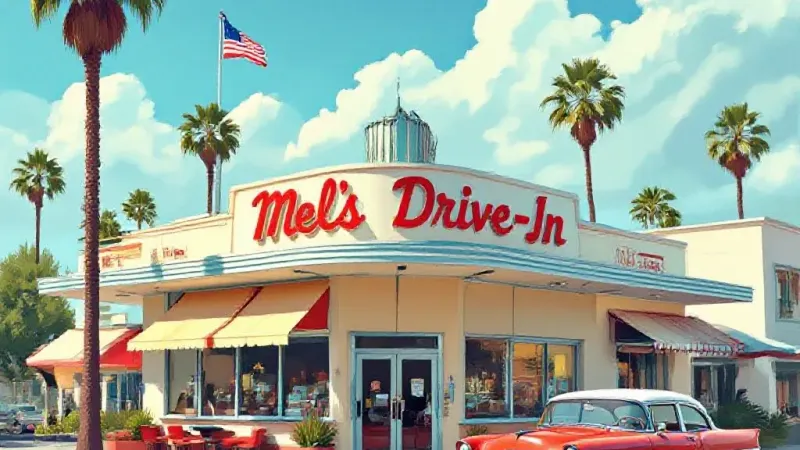
A landmark for decades at Lincoln and Olympic boulevards in Santa Monica, the building now home to Mel’s Drive-In is facing an uncertain future. Once the Penguin Coffee Shop, this mid-century structure marks the end of the legendary 2,400-mile westward journey of Route 66, and its potential demolition has sparked a push for historic preservation.
Property owners ValueRock Realty have filed preliminary paperwork to level the existing building. Their plan calls for an eight-story apartment building, including 138 units, 123 parking spaces, and ground-floor retail space. This move has spurred preservation groups into action.
The Santa Monica Conservancy and the Los Angeles Conservancy have nominated the site for protected status, citing its architectural significance. Nina Fresco, vice president of the Santa Monica Conservancy, said the building represents "the most significant representation of its style and period" in Santa Monica. She emphasized that the effort is about "preserving some really important Googie architecture," adding that "there’s no reason why housing and historic preservation can’t be partners."
Local residents and Route 66 enthusiasts are keeping a close eye on the Santa Monica Landmarks Commission, which will hold a hearing on Dec. 14 regarding the site’s nomination for protected status. If the commission grants landmark status, it could shield the building from demolition, though the owner would retain the right to appeal the decision to the City Council.
The Irvine-based ValueRock Realty purchased the half-acre property in 2020 for $6.2 million. At that time, ValueRock announced the property "is considered to be a historical landmark within the community." However, in their September filing for the proposed apartment project, ValueRock management indicated that no historic or cultural resources are known to exist on the site. Fresco noted that while the aggressive filing was unexpected, it was "not a huge surprise."
Under city law, any property over 40 years old requires the owner to wait at least 75 days after seeking a demolition permit before any demolition can occur. This regulation ensures the building’s safety, at least until the December hearing.
Today, Mel’s Drive-In remains open, serving a steady stream of locals and Route 66 travelers. Marilina Borchio, manager of Mel’s, confirmed the restaurant holds a lease through June 2029 and spends time reassuring customers who fear immediate demolition. Management at ValueRock Realty did not immediately respond to requests for comment regarding the plans.
The building itself, designed by famed mid-century architects Armet & Davis, opened in 1959 as the Penguin Coffee Shop. Architectural historians describe the Googie style as a bold form of Mid-Century Modernism, characterized by dramatic slanted roofs, oversize windows, and neon signs. It was particularly popular for restaurants, bowling alleys, and car washes, and is now increasingly rare in Southern California.
For years, the Penguin Coffee Shop, though never earning a Michelin star, garnered a following for its workaday American fare. A 1989 Times restaurant critic, Charles Perry, once declared it "the best diner around." The Penguin closed in 1991, and by 1992, the building briefly served as a dentist's office before sitting idle. The San Francisco-based Mel’s chain took over in 2016, undertaking a renovation to restore the restaurant’s 1950s atmosphere. The renewed restaurant opened in 2018, complete with a penguin atop its sign as an homage to its past.
Fresco, who is also a Santa Monica planning commissioner and former landmarks commissioner, noted that while some neon elements from the original design are gone, the main architectural features remain. The restoration efforts, which followed the Secretary of the Interior’s standards for historic properties, included removing layers of paint and tile to reveal original interior stone cladding, and replicating the counter, stools, vinyl booths, and terrazzo floor.
While the building is not listed in some prominent architectural guidebooks, it did receive a $10,000 grant in 2025 from the National Trust for Historic Preservation for a Route 66 centennial signage project. Rhys Martin, manager of the National Trust’s Preserve Route 66 initiative, stated that the site "represents something greater than itself" — a connection to a journey that could be lost if the Googie structure is demolished.
Fresco hopes for a compromise where the existing building could be retained while housing is added around it. She pointed to local examples, such as the preservation of a World War II-era Quonset hut at 829 Broadway within a five-story apartment building, and the 1875 Rapp Saloon at 1436 2nd Street, which now functions as a meeting space within a four-story hostel. If the building gains landmark status, Fresco believes the owners "will be able to do exactly what they want to do now. They will just have to do it differently."
Route 66, officially named U.S. Highway 66 in 1926, was extended to Santa Monica in 1935, with its official terminus at Lincoln and Olympic boulevards. Though decommissioned in the 1980s, its popularity as a historic driving route has only grown, particularly during its ongoing centennial celebration. The Dec. 14 hearing in Santa Monica will be a pivotal moment for this enduring piece of Southern California history and Americana.