
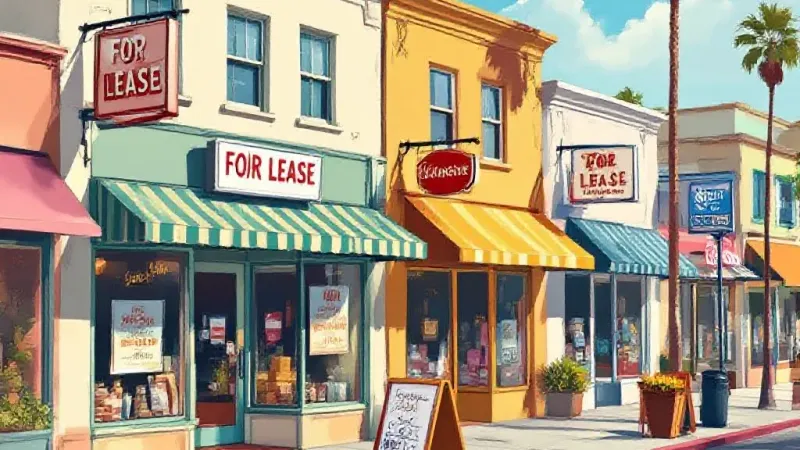
Santa Monica, once a significant economic driver for California just a decade ago, has experienced considerable economic struggles over the last six years, according to a new study from the Rand Corporation. The report indicates that these challenges predated the pandemic but were significantly exacerbated by COVID-19, with Santa Monica faring worse than neighboring cities like Beverly Hills, Culver City, and West Hollywood.
The study reveals a dramatic exodus of retailers, leaving behind noticeable empty storefronts in what were once bustling shopping centers. More than 11% of Santa Monica’s retail space is currently vacant, with approximately 45% of those empty spaces concentrated in the Third Street Promenade and Santa Monica Place. For comparison, West Hollywood’s retail vacancy rate stands at 9.2%, Beverly Hills’ is 6%, and Culver City’s is 5.2%.
According to the Rand report, Santa Monica’s retail sales revenue has not fully recovered to pre-pandemic levels. By 2025, clothing and accessory revenue had plummeted by 75% compared to 2015, and food services saw a 24% dip. Sales revenue in early 2026 remained about one-third below pre-pandemic figures. Tax revenue, much of it from large downtown retailers that have since left, reached only 89% of its 2015 baseline by 2021, falling further to about 60% by early 2026.
In contrast, Beverly Hills, Culver City, and West Hollywood, despite experiencing steep losses during the pandemic, saw their sales return to pre-pandemic levels by 2021. While these cities also saw subsequent declines, Beverly Hills and West Hollywood experienced a more modest 10% to 15% drop compared to pre-pandemic levels by the end of 2025. Culver City saw a 25% decline in sales over the same period.
Concerns about public safety and homelessness have been a persistent issue for the city. AJ Sacher, director of operations at Barney’s Beanery, noted a “lack of investment in the area,” observing that areas in disrepair can start to look scary, deterring shoppers. However, the Rand report found that data does not support an increase in housing insecurity or crime, noting instead a modest decrease in homelessness in 2026. While assaults and robberies are elevated compared to the early 2010s, over 70% of these incidents occur within 5% of the city’s area, primarily in the highly visible downtown and beachfront zones.
Santa Monica City Manager Oliver Chi stated that the Rand report accurately reflects the city’s financial woes, which prompted the launch of a realignment plan. He explained that Santa Monica’s economy was historically reliant on international tourism, and shifts in retail habits combined with a perception of increased unsafety have complicated recovery. The city also recently paid a settlement of over $229 million related to a former employee accused of preying on children, further impacting its financial health.
City officials declared the city in “fiscal distress” in September 2025. Now, leaders are focused on revitalizing the economy and increasing foot traffic, particularly in the Third Street Promenade. Plans include investing $3 million in the promenade and introducing a new “entertainment zone” where visitors can stroll with open alcoholic drinks between Wilshire Boulevard and Broadway. Chi acknowledged that $3 million is a substantial sum but likely insufficient.
Mayor Caroline Torosis affirmed the city’s focus on downtown, highlighting measures like cutting water and parking fees, limiting conditional use permits, and increasing police foot and bike patrols. “Santa Monica is open for business, and our best days are ahead,” Torosis said. Ryan Hawley, vice president of retail brokerage for JLL Los Angeles and a board member for Downtown Santa Monica Inc., reported seeing positive changes, noting that new businesses are reconsidering Santa Monica, and the city is actively working to shed its reputation for being difficult to navigate. Hawley added that the city's previous focus on international tourism had inadvertently alienated local shoppers, a trend now being reversed.