
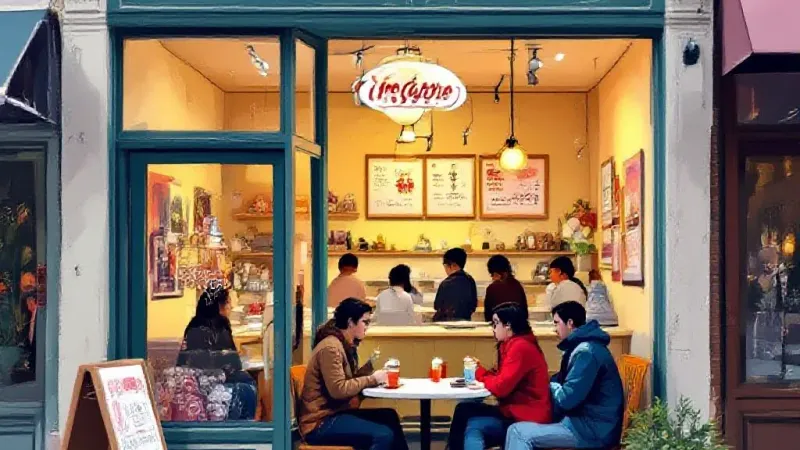
Running a cold treat shop in Southern California comes with a predictable hazard: the moment the temperature drops, locals stay home. As News from California, across the nation and world - Los Angeles Times reported, the owners of 28 Wishes Ice Cream Shop on Spring Street in downtown Los Angeles have found an unconventional way to deal with that drop in daily foot traffic by placing financial wagers on weather prediction markets.
Brothers Jason Jiang, age 37, and James Jiang, age 32, opened 28 Wishes in early 2020, right before the start of the COVID-19 pandemic. The shop specializes in a hybrid mix of gelato and American-style ice cream, serving popular options like Matcha Oreo alongside a flavor called Cookie Monster, which gets its organic blue hue from spirulina. But despite the warm local climate, business sensitive to temperature shifts faces real challenges whenever the weather turns cool or wet.
When temperatures in Los Angeles fall to 70 degrees or below, the shop routinely sees daily sales drop by 20% to 30%. Excessive summer heat waves also discourage buyers from ordering heavy desserts. To cushion those revenue declines, Jason Jiang drew on his previous background in banking to begin betting on weather forecasts using the online prediction platform Kalshi.
The system functions as an informal insurance policy. On October 21, when rain was forecast across the basin, Jiang logged into his account just after midnight to wager that rain would fall. He also placed money on the local temperature landing within two specific ranges: 71 to 72 degrees, and 73 to 74 degrees. That combination of bets returned roughly a 40% profit on the money risked, offsetting the loss in sales at the counter that day.
Depending on the daily forecast, Jiang places small wagers ranging from $20 or $30 up to $100 when he feels confident in a specific pattern. If the forecast misses, the business easily absorbs the small loss of the bet. If the prediction hits, the payout compensates for the missing foot traffic. While customers visiting the Spring Street counter remain largely focused on the rotating menu, the strategy allows the small business to stay financially balanced.
The tactic reflects a broader push across the hospitality sector to use prediction markets to hedge business risks. Sports bars in several American cities have increasingly placed bets against their local teams during postseason play to make up for lost revenue if a home team is eliminated. In Southern California, a large restaurant and bar group traded $60,000 against the Dodgers advancing to the World Series, aiming to recover lost cash flow if the team failed to secure an extended postseason run.
Local restaurant leaders say the impulse to hedge against quiet days stems from long-standing regional habits. Lien Ta, co-founder of the nonprofit organization Regarding Her and former operator of Los Angeles spots All Day Baby and Here’s Looking At You, noted that local diners look for reasons to stay indoors. While residents in cities such as New York or Paris venture out in frigid conditions, cold spells in Los Angeles reliably clear out dining rooms, leaving owners to carry the financial burden of sudden quiet nights.
Beyond weather-driven financial tools, shifting consumer habits are also reshaping how food businesses and residents think about kitchen materials. Concerns over microplastics have spurred growing demand for alternative housewares. Historical records show that industry and health experts gathered in 1974 to examine how exposure to polyvinyl chloride plastics affected workers, though marine biologist Richard Thompson did not coin the term microplastics until 2004. Today, growing consumer anxiety over plastic contamination has created a boom for glass houseware manufacturers, with industry forecasts projecting a 5% annual growth rate for consumer glassware through 2035 as households gradually eliminate plastic containers and utensils from their kitchens.