
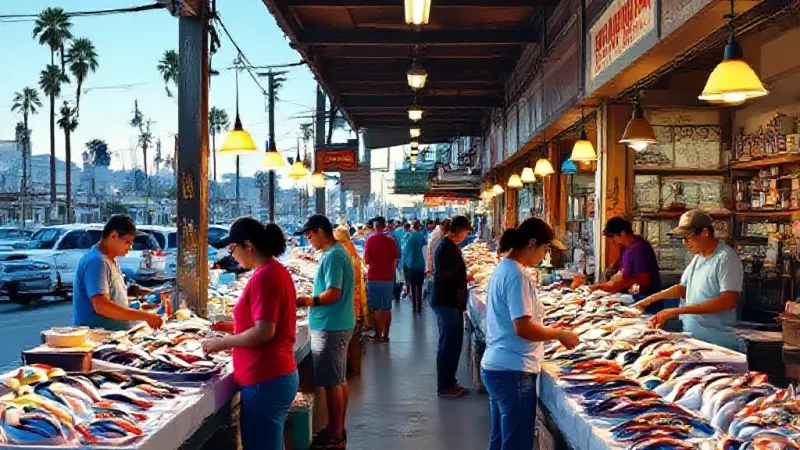
In San Pedro, a neon sign for the “Saturday Morning Fish Market” glows on a pink dockside building balcony long before dawn. Most of the harbor is quiet, with only the occasional gull or car breaking the stillness. But by 1 a.m. on Saturdays, a different kind of buzz begins, as people start to gather outside the market's roll-up door, some with backpacks ready for filling.
Precisely at 1:30 a.m., an employee in an orange apron lifts the door, letting white light spill onto the eager customers who then step inside onto the wet floor. What awaits them are “beauties” of the night: freshly caught fish, already filleted, deboned, and washed, resting on thick mountains of crushed ice. Shellfish, sardines, squid, mackerel, and glowing salmon filets are among the offerings. Employees use small nets to help customers pick crabs, while processing machines whir in an adjacent room. Out back, sea lions bark, seemingly hoping for scraps.
This unique early-morning shopping experience is at J Deluca Fish Co., a business that owner John DeLuca claims has been operating in some form since the late 1960s. As a child, DeLuca would greet his grandfather returning to the San Pedro port with his fresh catch. For decades, this wholesale seafood distributor opened its market to the public just once a week, from 1:30 to 7:30 a.m. on Saturdays, typically seeing a modest “smattering” of locals and seafaring types.
Neither John, 73, nor his son and co-owner Chris DeLuca, could have predicted the institution's recent surge in popularity, especially in an industry that has faced struggles for the past two decades. Before the pandemic, the market would see about 800 to 1,000 customers on a typical Saturday. Now, thanks to social media platforms like Instagram and TikTok, that number has swelled to up to 2,000 people walking through the doors, many of them visiting for the first time.
John DeLuca, for his part, admits he knows “absolutely zero” about Instagram and TikTok, but he's certainly aware of their impact. He notes, “People that live within walking distance never knew we existed. Now they do,” adding with a grin that “it’s got nothing to do with me.” Chris DeLuca points out the noticeable increase in young people at the market well before sunrise, seeing it as a new audience for a business that has changed significantly since his father's generation. He suggests that people are drawn to “those hidden gems and people like that fresh seafood experience.”
Inside the bustling market, between rows of sea bass and salmon, customers are busy choosing their haul. Abdul Fahwami, a regular in jeans and flip-flops, visits at least once or twice a month, depending on how many guests he's hosting. He typically buys between 100 and 200 pounds of fish, with red snapper being a favorite. He also keeps an eye out for branzino; on one recent morning, he found only 11 pieces and “took all of it!” Customers can also watch as employees process their selections, scaling, gutting, and filleting the fish.
Prices fluctuate weekly based on supply, but market representative Joe Castelao states they are typically 10% to 40% less than at standard stores. While the team values the “quality of our products” over “trying to cater to bargain finders,” the ability to buy seafood in bulk is a significant advantage not often found at local grocers.
Terry Jackson, waiting in line wearing black overalls, described the early trip as “definitely worth waking up a little early” for the quality and pricing. His current favorite is tuna, proudly holding a bag of bright red filets.
The market also sees a father-son employee duo, Mike and George Stahl, briskly pacing the floor in their orange aprons. Mike Stahl moved to California in 2018 and joined J Deluca Fish Co. after two decades in the seafood business, noting that “no two days are the same.” During the pandemic, he brought his son George into the fold, who has since become a “micro-celebrity” appearing in the market's Instagram posts, though he plans to pursue a career as a physical therapist.
Despite the current wave of success, John DeLuca offers a somber perspective on the broader fishing and seafood industry. He describes it as “a dying business,” citing difficulties for seiners to make a living due to restrictions, overfishing, and changing regulations. Still, for now, the market is thriving. As customers leave in the wee hours, proudly carrying their bags of fresh catch, John DeLuca reflects, “But we’re still here.”