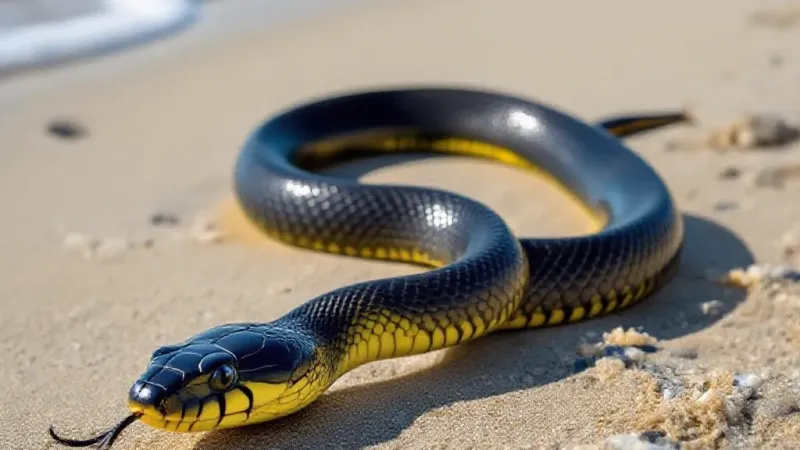
A rare yellow-bellied sea snake recently washed ashore in Orange County, marking what social media video suggests is the first sighting of the venomous serpent in California since 2018. The unusual appearance in Crystal Cove follows other rare marine animal sightings this year, which naturalists and experts connect to the region's warming ocean waters.
Cellphone camera footage broadcast by CBS Los Angeles showed the distinctive yellow and dark-colored snake on a Crystal Cove beach at night. The video captured someone attempting to use what appeared to be the base of a palm frond to pick up the snake and return it to the water.
While seeing such a creature this far north is uncommon, it is not entirely unheard of. Greg Pauly, a reptile expert with the Natural History Museum of Los Angeles County, noted two other yellow-bellied sea snake sightings in Orange County in January and November of 2018. He also stated there have been six confirmed sightings across California since 1972. Beyond these, the Natural History Museum of Los Angeles County recently added a rare yellow-bellied sea snake specimen to its collection, the first known report of the species in Southern California since 1983, following its discovery last week.
Naturalists believe that poisonous sea snakes, which typically inhabit more southerly waters, are being drawn far north of their usual habitat by warming ocean conditions, potentially linked to El Niño. Pauly pointed out that Friday’s reported sighting would be particularly unusual due to its early occurrence in the year, as previous cases often involved snakes washing ashore when water temperatures dropped, causing them to become sick and lethargic. Pauly is currently working to contact those who saw the recent snake to obtain more video and verify the sighting.
These yellow-bellied sea snakes are one of about 65 to 75 species of “true” sea snakes, meaning they spend their entire lives in the ocean and give birth to live young at sea. They are entirely adapted to marine life, making them helpless and nearly immobile if they wash up on a beach.
Experts emphasize that the snakes are not considered dangerous to people, provided they are not handled. Hayley Crowell, a snake expert at San Diego State University, explained that humans do not resemble food to these serpents, which use their potent venom to kill prey. “You have to do a lot to get bit by one,” Crowell said, adding that “If you’re not handling them, you’re fine.”
Crowell observed that these snakes primarily hunt fish in open water and can easily be caught in currents. If they are blown off course and find themselves far from home, they may not realize it as long as the water temperature remains within their comfort zone. “They’re kind of like floating noodles who got lost,” Crowell remarked.
The recent sea snake sighting is part of a broader trend of unusual marine animals appearing in California waters this year. Fishermen recorded a hammerhead shark off the Malibu Pier last month, and another was seen off Laguna Beach this month, according to the Orange County Register. Additionally, a whale shark was spotted between Malibu and Santa Barbara Island earlier this month. The Natural History Museum also announced Wednesday that a longfinned bigeye fish, typically found only from Baja California to Peru, was caught off the Venice Fishing Pier.
While Crowell expressed that it was “heartening” to see someone attempting to help the sea snake in the video footage, she generally recommends contacting wildlife officials for assistance in such situations. She cautioned against interacting with such animals without proper knowledge.