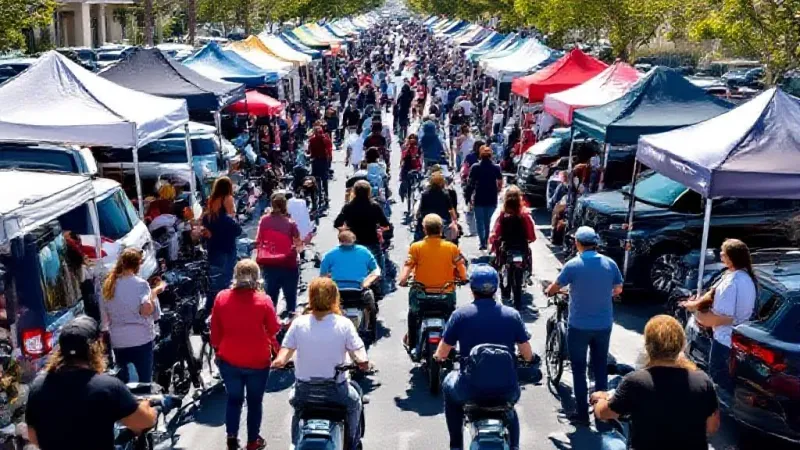
The Orange County District Attorney’s office recently held an e-bike buyback event, the first of its kind in the U.S., which collected nearly a thousand e-bikes, e-scooters, and e-motorcycles from residents. The program, which authorities characterized as an effort to get "dangerous and deadly weapon" e-bikes off the streets, drew significant crowds and also some online criticism.
Held on a Sunday, the event was modeled after gun buyback programs and allowed participants to trade an e-bike for a gift card ranging from $200 to $1,000, depending on the type of vehicle. According to Kimberly Edds, a spokesperson for the district attorney’s office and the person Dist. Atty. Todd Spitzer credited with the concept, nearly 1,000 vehicles were surrendered in total. These vehicles filled nine 26-foot U-Haul trucks. The office had budgeted over $100,000 for the program, a figure Dist. Atty. Spitzer said he didn't expect to hit.
The gift cards, redeemable at Target, Walmart, Dick’s Sporting Goods, and Best Buy, were paid for using asset forfeiture funds, which are reserved for crime prevention. Orange County Supervisor Katrina Foley also contributed an additional $5,000 to the effort. Dist. Atty. Spitzer noted that the program did not require recipients to make promises about future e-bike purchases, as the goal was to encourage surrender without scrutinizing individual motivations. He also mentioned that bikes with serial numbers were run through databases to check for stolen status.
The buyback drew massive lines, with the first person arriving at midnight Sunday, even though the event didn't start until 10 a.m. The last gift card of the day went to a father-son duo who reportedly began waiting at 7:30 a.m. The first 75 participants also received a pair of tickets to a Los Angeles Angels baseball game. Even after the office ran out of gift cards, people reportedly continued to give up their e-bikes, according to Edds.
Despite the turnout, the program faced some online criticism, including concerns that it was a waste of resources. Dist. Atty. Spitzer acknowledged this "blowback," stating he was "getting lit up on Nextdoor" and had been responding to critics. Much of the criticism questioned the program's use of funds and whether surrendered bikes could have been stolen. Spitzer addressed the funding concerns by explaining the use of asset forfeiture funds. One Reddit user described the event as a "performative action."
After collection, the surrendered vehicles are set for proper disposal. Edds stated that an environmental contractor would first remove the lithium batteries, and then the bikes would be taken to a recycling center to be shredded.
The buyback event comes as e-bike injuries are reportedly increasing across California, with injured riders often 14 or younger. Dist. Atty. Spitzer views the buyback as part of a broader, "multi-pronged push" to reduce risky riding and collisions. Other efforts include advocating for legislative changes, such as mandating safety classes and requiring licenses for young riders, increasing enforcement by police and the county Sheriff’s Department, and offering voluntary safety classes. Spitzer has also taken an aggressive stance on parents, stating he is "not just prosecuting kids," but also their parents if they knowingly bought or modified inappropriate e-bikes for their children. Since January, the district attorney’s office has filed child endangerment charges against four parents under these circumstances.
Looking ahead, Dist. Atty. Spitzer is considering future e-bike buyback events, but with potential modifications. These might include setting up multiple processing lines to speed up the process and limiting participation to Orange County residents or those with a verifiable connection to the county, unlike the "no questions asked" approach to residency at the recent event. The primary factor for any future events, Spitzer noted, would be funding. Dist. Atty. Spitzer stated that he does not have unlimited asset forfeiture funds, raising the question of whether taxpayers would be willing to support such initiatives if public money were needed. It is too soon, he added, to know if the buyback event will significantly impact street safety.