
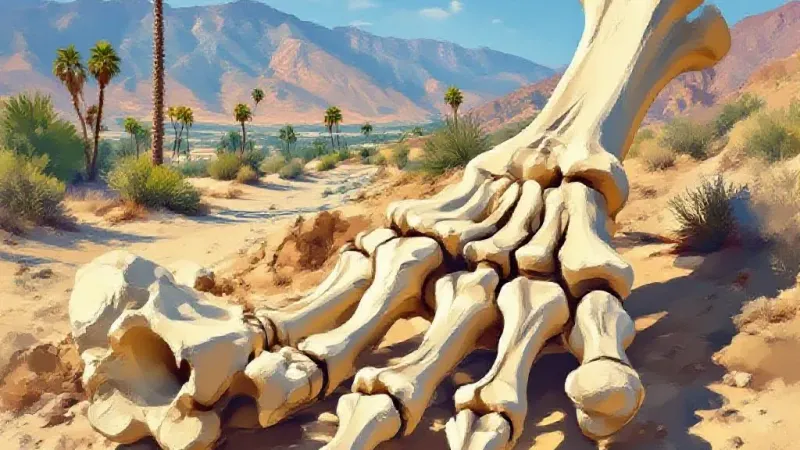
Southern California work crews performing routine excavation for a water infrastructure project in Oceanside recently uncovered the fossilized remains of a massive mammal.
Scientists suggest the animal, which inhabited what is now Oceanside around 40 million years ago, could be from one of two extinct families: a Brontotheriidae, often called a “thunder beast,” or an Amynodon, known as a “swamp rhino.” The city of Oceanside confirmed the discovery in a recent statement, noting that crews unearthed several limb bones, ribs, and other fragments likely belonging to a single animal.
Joseph El Adli, a consulting paleontologist whose firm was overseeing the construction site, spoke about the find. The largest of the fossil bones measured more than two feet long and were found approximately 12 feet below the surface. El Adli discovered the first fossil fragment on August 31.
The excavation process, which took about 10 days, was prolonged because the fossils were encased in very hard mudstone, buried under six feet of rock. Workers were digging in a fossil-rich sedimentary rock unit known as the Santiago Formation, in an area El Adli identified as potentially an ancient floodplain.
El Adli indicated the fossils likely belonged to an animal from the Uintan North American Land Mammal Age. One possibility is the Brontotheriidae, a massive, hoofed mammal characterized by a deep chest and a pronounced hump at the shoulder. Another candidate is the Amynodon, an extinct family of large-bodied herbivores distantly related to rhinos. These semi-aquatic animals were notable for their barrel-shaped torsos and canine teeth instead of a horn.
Even without a skull, El Adli was able to narrow down the possibilities to these two candidates because of the size of the limb bones and the fact that the fossils came from a rock layer that typically contains few cow-sized animals. He expressed hope for future discoveries at the site: “It’s just sort of a hope and a prayer at this point, but that would be fantastic,” he said, referring to the possibility of finding teeth or a lower jaw, which would be key to further identifying the animal.
For public safety and to preserve the site's integrity, Oceanside is not disclosing the exact location where the fossils were found. The rocks of the Santiago Formation have previously yielded other significant finds, including early saber-toothed carnivores and primates, according to El Adli.
The Oceanside discovery adds another chapter to Southern California’s rich fossil history, which frequently comes to light during modern construction projects. In San Pedro in 2024, for instance, construction workers uncovered a massive deposit of marine fossils beneath a local high school. In 2017, the extension of L.A.’s Metro D Line led to the discovery of camel and possible mammoth fossils. Even further back, in 2009, a huge cache of ice age fossils—including a nearly intact skeleton of a Columbian mammoth dubbed Zed—was found in L.A.’s Miracle Mile, beneath the parking lot of a former May Co. building.
The newly unearthed specimens have been transported to a lab in Carlsbad for further study. They will eventually be transferred to a museum, with the San Diego Natural History Museum or the Los Angeles County Natural History Museum being potential future homes. El Adli noted that as construction continues in Oceanside, it's possible more fossils could still be uncovered.