
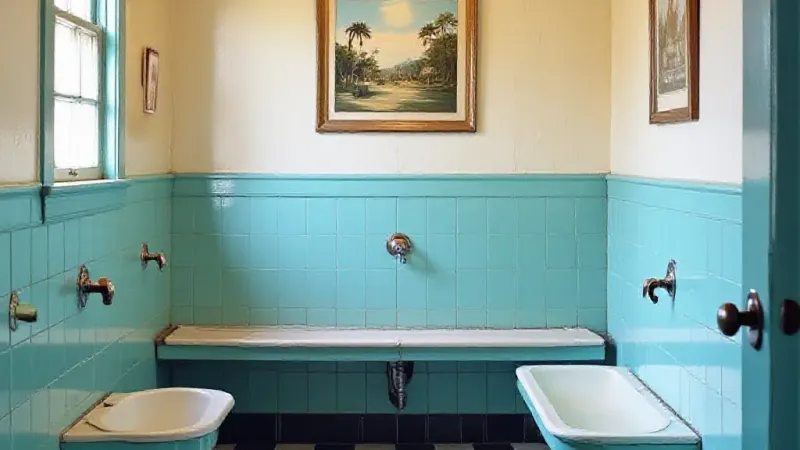
Public restrooms, often seen as a mundane necessity, have historically served as significant sites for social movements and conflict, according to Temple University professor Bryant Simon. Simon, a one-time postdoctoral fellow at Caltech and author of "For Customers Only: Public Bathrooms and the Making of American Inequality," points to these spaces as central to various debates. In Long Beach, over a century ago, they became a battleground in the city's "war against homosexuality."
Initially, the city embraced public restrooms. Simon notes their "bright white sinks and fancy flush toilets" were intended to project an image of Long Beach as refined and attractive for investment. However, this perception shifted dramatically in the spring of 1914. Undercover sting operations, documented in L.A. Times clippings, led to the arrest of 31 men on suspicion of "social vagrancy," initiating what Simon describes as "a tsunami of homophobia" in Long Beach.
The "purity campaign" was spearheaded by B.C. Brown and H.W. Warren, described as "two handsome failed actors" hired as vice officers. They specifically targeted public restrooms, which Simon characterized as the campaign's "ground zero." Officers reportedly styled their outfits with lapel flowers and pastel shirts, seeking men who "walked with a swish in their step." Their tactics involved conversations, passing notes, or "explicit" comments to lure suspects into stalls. If a suspect exposed their genitals, officers would mark them with an "indelible marker" for immediate arrest.
These vice officers were paid $10 per arrest, earning as much as $150 a day; Simon calculates this would be roughly $5,000 daily in 2026 dollars. The 1914 sting alone resulted in combined fines totaling $5,275. Beyond financial penalties, arrested men faced severe social ostracization: eviction notices, pink slips, club membership revocations, and divorces. The consequences proved tragic for Scottish immigrant Josh Lamb, who committed suicide by ingesting cyanide after his name appeared in local newspapers.
Decades later, by the late 1960s, the gay rights movement arrived in Long Beach. Activists challenged the police department's ongoing bathroom entrapment tactics. Simon writes they "called for equal rights, an end to discrimination, and the opening of the closet door." Interestingly, these activists also engaged in self-policing, advocating for a "strategic end to public sex." One gay rights group even offered to dispatch community members to "shoo sex seekers from public bathrooms" and urged the city to close facilities at night.
Despite efforts from both law enforcement and activists, public sex in restrooms was never entirely eradicated. Eventually, the focus of police raids shifted from public bathrooms to establishments like bars featuring rainbow flags and drag shows. This shift ultimately left the once-targeted restrooms largely "relegated to a forgotten state."