
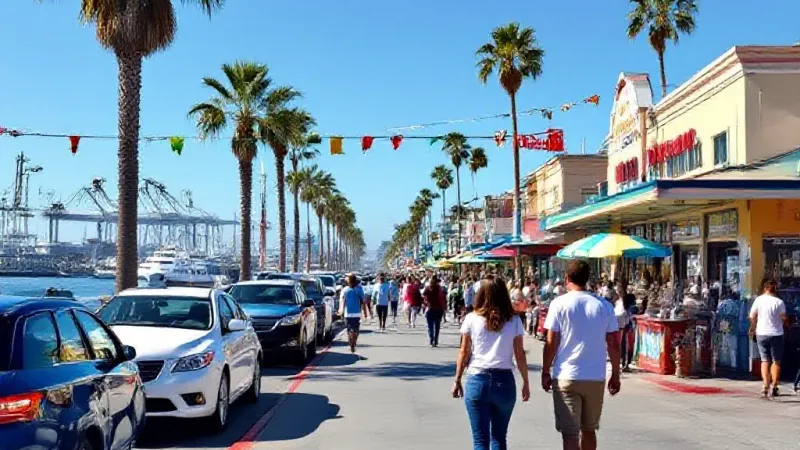
The Port of Long Beach, America’s second largest port, is exploring a partnership with startup Bluecore Energy to develop small, floating nuclear power plants. Announced last month, this collaboration aims to harness emissions-free energy from these modular reactors on barges, eventually powering the port's operations and potentially cities. The concept involves anchoring these plants off the coast, with undersea cables delivering electricity to port facilities, charging stations, and equipment.
Bluecore Energy, founded by Kofi Asante, 31, has already raised $10 million and begun development in a 10,000 square foot warehouse at Berth 48 within the port. Asante, who previously worked at electric boat company Arc and Uber Freight, leads a team with experience from SpaceX, Rivian, Northrop Grumman, and the U.S. Navy. He stated his company is working on a relatively new form of nuclear power using small modular reactors (SMRs). These SMRs, unlike traditional large nuclear plants, are designed to be smaller, easier to cool, and can be built in factories. Adam Stein, director of nuclear energy and innovation at the Breakthrough Institute, noted that factory construction allows for better quality control, understanding of costs, and consistency.
The Port of Long Beach is working towards ambitious goals, aiming to double its container volume by 2050 while simultaneously eliminating carbon emissions. Port Chief Executive Noel Hacegaba emphasized the need for innovation, stating, "Yesterday’s energy system won’t power tomorrow’s port." While no SMRs currently supply power to the commercial electric grid in the United States, the military has used tiny reactors in aircraft carriers and submarines for years, and the Army plans to implement nuclear microreactors at five military bases.
Despite company assertions that SMRs are safer due to their size, critics have raised concerns. Alan J. Kuperman, coordinator of the Nuclear Proliferation Prevention Project, has called reactors uneconomical and expressed worry about the spread of nuclear weapons. The Union of Concerned Scientists also highlighted safety and security risks, including potential terrorist attacks. Port Chief Executive Hacegaba assured the public that nothing could move forward without federal approval in a public process, acknowledging the community's two-decade history of holding the port accountable on air quality and safety.
The development of nuclear power is overseen by multiple entities, including the Nuclear Regulatory Commission, the Department of Energy, and the Environmental Protection Agency. For this specific project, the Coast Guard and the U.S. Maritime Administration (MARAD) are also involved. The Port of Long Beach signed a memorandum of cooperation with MARAD in July, with Chief Executive Hacegaba noting it aims to prepare safety protocols, infrastructure, and regulatory readiness as the technology matures. It is expected to be years before Bluecore Energy and other companies in this field gain approval and bring a product to market.