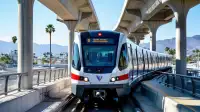

The LAX SkyLink people mover, an automated transit system designed to connect travelers to Los Angeles International Airport terminals, has seen its targeted completion pushed into next year. Approved by the L.A. City Council in 2018 with construction beginning in 2019, the project was initially slated for a 2023 startup. Now, nearly eight years after its approval, the trains remain unmoving, and the project's cost has swelled from an initial $1.9 billion to $3.3 billion.
For a sense of perspective on the timeline, Walt Disney reportedly spotted a monorail in Europe in the summer of 1957. Design and construction began in 1958, and Disneyland had its monorail operating the following year. Los Angeles City Councilmember Monica Rodriguez noted that Disney imagineer Bob Gurr, who helped design the original Disneyland monorail, lives in her district. Rodriguez joked about Gurr bringing "a little magic" to the LAX project, adding, "we get an E Ticket ride" if he did.
The significant delays and cost overruns have led to finger-pointing, litigation, and a grand jury probe. The grand jury report detailed an arrangement where L.A. World Airports (LAWA) awarded authority for designing, building, and operating the system to a private contracting consortium named LINXS, for LAX Integrated Express Solution. While the grand jury found no criminal activity, it did report a "considerable amount of eyebrow-raising behavior." The contractor sued the city, claiming city-caused delays, but the grand jury suggested the contractor was responsible, "holding out for payment of $550 million in settlement claims." City officials were reportedly keen to have the trains running by the 2028 Olympics, having already missed the World Cup matches.
This ongoing delay at LAX presents a challenge for Los Angeles mayoral incumbent Karen Bass and her challenger, Councilmember Nithya Raman, heading into next year. Mayor Bass, who chairs Metro and appoints airport commissioners, stated the LAX project began before she took office. Regarding disputes that caused delays, Bass said her administration "pushed for a settlement so there would be a firm finish line."
The people mover, which is only 2.25 miles long, is intended to finally allow rail passengers to connect directly to LAX. The project’s troubles are part of a larger pattern in regional transportation initiatives. For example, the Green Line was supposed to extend to the airport in the 1990s but did not. Metro's Purple Line, sometimes called the "Subway to the Sea," would still stop 3.5 miles short of the beach even if its next phase is completed, though the E Line now reaches downtown Santa Monica.
Other projects also show similar trends: construction recently began on the Van Nuys-Pacoima light rail line, with its cost having increased from an original $1.3 billion to almost $4 billion. Construction is also starting this week on Metro’s East San Fernando Valley light rail project, with service targeted for 2032.
James Moore, an emeritus engineering professor at USC, called the situation "an embarrassment." He acknowledged the people mover is a sophisticated engineering feat but noted that "countless airports around the world have figured out how to get the job done." Moore concluded, "Should it have taken this long? No," adding that "when anything goes right in Los Angeles, that’s when I’m surprised." Councilmember Rodriguez explicitly stated her concern about the people mover's contract language affecting other public-private partnerships, noting she voted against the upcoming convention center expansion, saying, "Whatever contract language was in the people mover contract, make sure it’s not in the convention center project."
The delays extend beyond just rail. The Vision Zero plan, introduced 11 years ago by then-Mayor Eric Garcetti to eliminate traffic deaths through roadway design, has fallen "far short." Damian Kevitt of Streets Are for Everyone noted that for three years running, L.A. has had more traffic fatalities than homicides. Kevitt described the people mover as "almost an indicator of systemic issues across the city," attributing problems to a "lack of leadership" at multiple levels.