
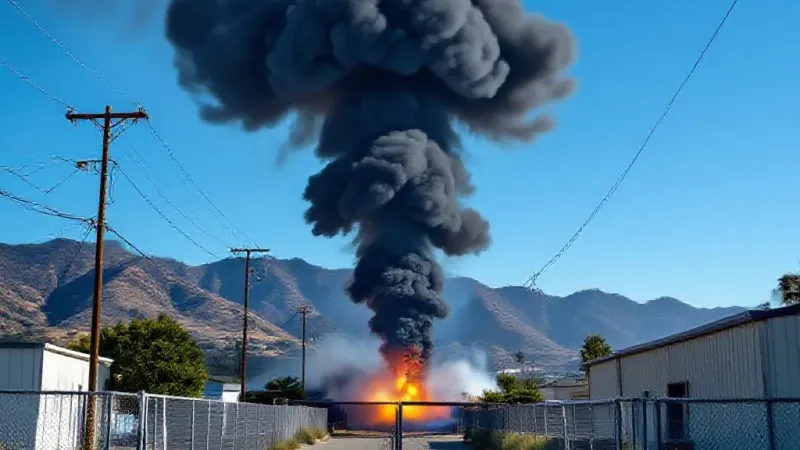
A hazardous lithium-ion battery fire at a Metropolitan Water District of Southern California facility in La Verne on Tuesday prompted evacuations and shelter-in-place orders for nearby residents and schools. The incident, which began shortly after 11:40 a.m. at the Wheeler Avenue facility, involved a “significant explosion” when La Verne and Los Angeles County fire departments arrived on scene, according to La Verne Fire Department Battalion Chief Mark Savage.
The fire originated at a battery energy storage system located near a solar panel field on the northeast side of the facility, which also houses the Weymouth Water Treatment Plant. One civilian was injured and transported to a hospital for treatment. Fire crews initially took a defensive position to address the burning batteries.
In response to the blaze, the La Verne Police Department issued evacuation orders around 12:30 p.m. for residents living near Wheeler and Bonita avenues. Grace Miller Elementary and Bonita High schools were placed under shelter-in-place orders. The University of La Verne canceled classes until further notice, instructing students, faculty, and staff to leave immediately. An evacuation shelter was established at the La Verne Community Center, located at 3680 D St.
The Metropolitan Water District of Southern California confirmed that “The safety of Metropolitan’s water supply is not affected,” and stated their support for first responders in ensuring the health and safety of those in the affected area.
After assessing the safety conditions, firefighters were able to begin cooling the batteries with water, which significantly reduced the risk to the public. By shortly before 3 p.m., most evacuation orders were downgraded to warnings, though orders remained in effect for the immediate vicinity of the facility.
Lithium-ion battery fires present particular challenges for firefighters. The intense heat within the battery can trigger a self-sustaining chemical reaction known as thermal runaway. Once thermal runaway begins, the process cannot be stopped, causing batteries to burn for hours. Large, multiple-battery fires can even burn for days, releasing toxic gases such as hydrogen fluoride, hydrogen chloride, carbon monoxide, and carbon dioxide. Battalion Chief Savage, however, characterized the La Verne incident as involving a “smaller battery storage facility,” describing it as “about the size of a large pickup truck.” He anticipated the situation would be “looking really good before the sun sets.”
The facility’s immediate area remained under an evacuation order as of late Tuesday, with authorities directing residents to an online map for specific details on affected zones.