
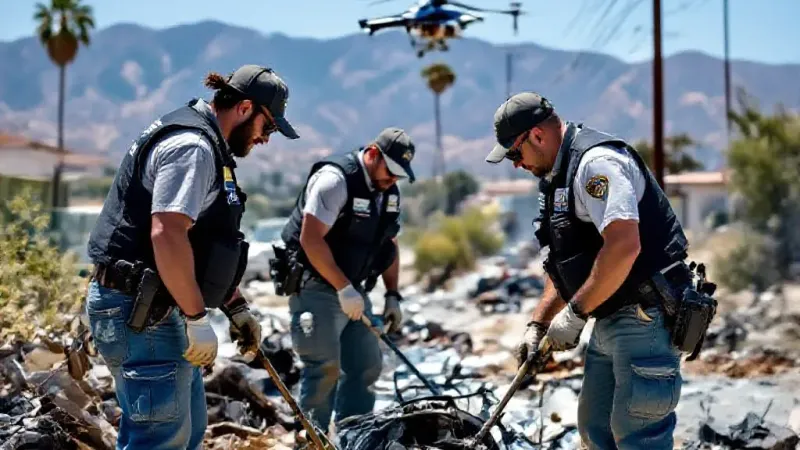
Federal investigators are piecing together the events that led to the crash of an NBC4 news helicopter in Chatsworth, an incident that killed two station journalists and a bystander on the ground. The helicopter, which was among several news aircraft covering a deadly bus crash on Tuesday evening, went down around 7 p.m., hitting shipping containers and vehicles outside a warehouse.
Reporter Eliana Moreno, pilot George Marciniw, and 29-year-old Edy Gutierrez Mejia, who was on the ground, died in the crash. The helicopter burst into flames after impact, a few blocks away from the initial bus accident scene.
NTSB Investigator Fabian Salazar stated that a video stream from the helicopter's coverage of the bus crash is likely the most important evidence recovered so far. The footage reportedly shows the helicopter hovering just before it began to drop, with an alarm blaring as it rapidly lost altitude. Inside the helicopter, Moreno was heard reacting to the noise with a quiet, “Uh-oh,” followed by, “You can’t pull up?” before the video cut out.
Several experts who reviewed the recordings offered insights into potential mechanical issues. Jack Cress, a former helicopter pilot for the U.S. Marine Corps and an instructor at USC’s Aviation Safety and Security Program, said the blaring alarm would indicate a possible engine failure, a loss of propeller rotation, or a problem with the hydraulic system. Jeff Guzzetti, a former NTSB and FAA investigator and also an instructor at USC’s Aviation Safety and Security Program, agreed that the horn in the video was likely a low rotor RPM alarm. He noted that the audio seemed to suggest a mechanical problem, describing “something mechanical that is winding down in the background.” NTSB investigators are focusing on the recording where the engine's motor winds down and a horn blares, potentially signaling a drop in main rotor speed or a loss of hydraulics.
Cress explained that if a helicopter suddenly loses RPMs, pilots are trained in a safety maneuver called autorotation. This involves using the downward and forward momentum to increase rotor blade rotation and control the landing. However, Cress indicated that the helicopter’s apparent hovering and low altitude would have made executing such a maneuver extremely difficult.
“He’s in the worst part of the height-velocity curve,” Cress said, referring to a chart pilots use to track safe flight conditions. He added that pilots are trained to avoid such conditions because a lack of altitude and forward momentum offers little recourse during engine trouble. Guzzetti referred to these conditions of hovering with little altitude and no momentum as a “dead man’s curve,” calling it “the worst place to be if you have a problem.”
Thomas Anthony, director of USC’s Aviation Safety and Security Program, noted that the AS350 B2 helicopter model involved in the crash is very common and usually reliable, calling it “the workhorse of the helicopter fleet.” It is frequently used for both law enforcement and news gathering due to its reliability, ease of repair, and strong manufacturer support. However, Anthony pointed out that the nature of news and police work, which often forces pilots into unpredictable conditions, inherently increases risk.
Cress further explained that while the single-engine and light design of the AS350 B2 contribute to its overall good safety record and reliability, they also mean there is no secondary engine to assist in an engine failure. Additionally, the light design of the rotors means they can lose momentum quickly if the engine fails, compounding the challenge for a pilot in a difficult situation.