The Hollywood Burbank Airport officially unveiled its new $1.3 billion terminal Tuesday morning, marking a significant overhaul for the San Fernando Valley's busiest air hub. After 33 months of construction, the facility at Winona Avenue and Hollywood Way welcomed its first passengers with a medley of arrivals and departures just after 7 a.m.
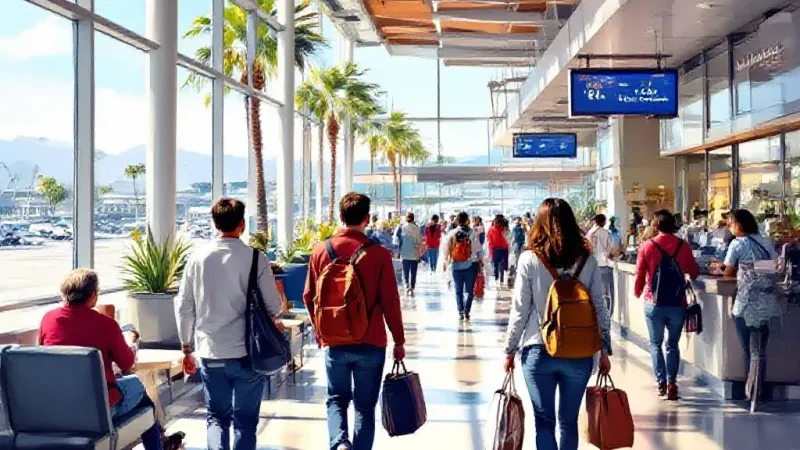
Travelers accustomed to the snug, Spanish Colonial Revival style of the 1930s-era terminal found themselves in a sleek, larger space. The new design features high ceilings, contemporary art, twinkling terrazzo floors, and landscaping filled with cacti and succulents. Amenities like abundant charging stations, primarily USB-C ports, are available from every seat, and passengers could be seen gawking at mirrored grid artwork overhead.
The first departure, Alaska Flight 3401 to Santa Rosa, left at 7:03 a.m. with 33 passengers. Shortly after, Southwest Flight 189 from Las Vegas became the first arrival, landing at 7:16 a.m. with 30 passengers aboard. Southwest Airlines pilot Mike Petros, arriving at 7:31 a.m. from Sacramento, noted the change in procedure, stating they informed passengers that "we would be flying to a new terminal."
Despite advance notice, many travelers were surprised by the switch. Tanya Radke, 25, of Van Nuys, headed to Kansas City, described it as "weird" and "not what I thought was going to happen today." However, she quickly called the new space a "big upgrade," saying it reminded her of the Kansas City airport and was "well overdue." Airport management deployed several staffers to help redirect confused travelers from the now-idle old terminals to the new location. Anthony Bailey, 29, en route to Las Vegas, learned of the change from his Uber driver and shared a positive initial impression, finding the terminal "Nice and clean. The TSA line was pretty smooth."
The new building measures approximately 355,000 square feet, making it about 50% larger than the two old terminals combined. While it retains the same two runways and 14 gates, many aspects have been upgraded. The walk from the entrance to the farthest gate is now 1,285 feet, down from 1,600 feet, featuring wider corridors and sidewalks. Security has also been bolstered with eight Transportation Security Administration lines, an increase from five in the previous setup. Notably, baggage claim carousels have moved from outdoors to indoors, a significant improvement. Travelers will still often board planes directly from the tarmac using outdoor steps, a practice many have praised for its informal efficiency.
On opening day, while most of the six retail stores were operational, none of the terminal’s 13 planned food concessions were fully open. Only two eateries offered grab-and-go options, and airport spokesperson Mike Christensen indicated that more dining choices would become available later in the day and week. This shortage was a point of frustration for some passengers, including William Langlois and Annie Cerillo of Tampa, Florida, who had initially gone to the old terminal. Langlois called the situation "horrible," noting "there’s no restaurants and not enough security stations." Cerillo added that before this change, Burbank "was the easiest airport."
When fully operational, the terminal will feature a diverse array of dining options including Guy Fieri’s Flavor Town, Spring Chicken, Diane’s Farm Table and Italian Market, Jones Coffee, Perry’s Joint, Poquito Mas, West Coast Smash Burgers, Massis Kabob, Starbucks, Border Grill, Jet Tila’s Asian Table, Santa Canela bakery, and Pete’s Pub, a bar with views of the runways and Verdugo Mountains.
Beyond the terminal itself, a new parking structure offers about 2,000 spots, including 310 charging ports for electric vehicles. The airport's total parking capacity remains at 6,637 spaces. Shuttle bus service continues to connect the terminal to the Burbank Airport-South Train Station, which serves Amtrak’s Pacific Surfliner, and the Burbank Airport-North Station.
The project, approved by voters in 2016, addresses long-standing safety concerns. The previous facility, built in 1930, did not meet current state seismic standards or Federal Aviation Administration design standards. The new design substantially increases the distance between the terminal and the nearest runway to about 880 feet, up from as little as 257 feet, bringing the airport into FAA compliance. Ahead of the opening, airport officials conducted a "passenger simulation trial" on September 19, involving 1,500 volunteers to prepare staff for the transition.
The Hollywood Burbank Airport, operated by the Burbank-Glendale-Pasadena Airport Authority, is the second busiest in Los Angeles County. For decades, it has been a favored alternative to Los Angeles International Airport for local travelers due to its simplicity and speed. Located in the San Fernando Valley, the airport operates with limited hours, from 7 a.m. to 10 p.m., a contrast to LAX’s 24-hour operations. Tyron Hampton, president of the airport authority and a Pasadena City Council member, called the new facility "a beautiful building," expressing confidence it would attract both new passengers and businesses to the commercial corridor along Winona Avenue. When asked about LAX, Hampton demurred, noting, "We have 14 gates. LAX has 161."