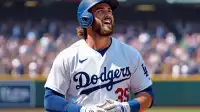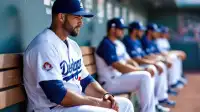

The Dodgers found out their National League Championship Series opponent Saturday night, watching the Milwaukee Brewers secure a 3-1 win over the Philadelphia Phillies in Game 5 of their NLDS. As the Dodgers worked out at Dodger Stadium, preparing for their own upcoming series, manager Dave Roberts noted they were "doing our due diligence" and would have the game on the big board. Now, a trip to the World Series is on the line, with Game 1 of the NLCS set to open Monday at American Family Field.
Milwaukee’s approach to the game looks different from what Southern California fans might be used to seeing. This year, the Brewers operated with a $143-million payroll, less than 20 other teams in Major League Baseball, including the Colorado Rockies. It was also nearly one-third the size of the Dodgers' payroll. This budget reality meant the Brewers built their team around a particular brand of "small-ball" baseball, emphasizing getting on base, making contact, and putting pressure on defenses.
Their offense ranked third in the majors in scoring this season. They achieved this by ranking third in batting average (.258) and fourth in walks. The team focused on swinging at good pitches, recording the fifth-fewest strikeouts and chasing pitches out of the zone at the lowest rate in MLB. They also had the majors’ third-lowest whiff rate and ranked second in stolen bases. With runners in scoring position, they held the second-best batting average. This style allowed them to minimize reliance on home runs, ranking 22nd in the league in big flies, with only 33% of their runs coming via the long ball. This focused identity led to a 97-65 record, the winningest season in their franchise's history.
The Brewers' strategy stems from their manager, Pat Murphy, a 66-year-old former college coach with three decades helming programs at Notre Dame and Arizona State. Murphy, who became the Brewers’ manager two years ago after serving as bench coach since 2016, is known for his big personality, hands-on approach, and unique habits, like eating "pocket pancakes" during games.
Despite the attention on their unique offense and manager, the Brewers’ pitching staff is considered the backbone of the team. Known for developing pitching talent despite their budget, Milwaukee’s staff ranked second in the majors in team ERA this season, third in batting average allowed, and fifth in strikeouts. The team's rotation had the third-best ERA but logged the fifth-fewest innings, while their bullpen ranked sixth in ERA and fifth in save percentage, indicating a full-team production approach.
The Dodgers experienced this firsthand earlier this year, being swept twice by Milwaukee in July. In those six games, the Dodgers managed only 16 runs, nine fewer than they scored against any other National League team. Their batting average against Milwaukee was .179, lower than against any opponent except the Texas Rangers.
Veteran right-hander Freddy Peralta was the Brewers’ true ace this season. A two-time All-Star, Peralta delivered a career-best performance with a 2.70 ERA, an NL-best 17 wins in 33 starts, and 204 strikeouts in 176 ⅔ innings. He started Game 1 of the NLDS, striking out nine over 5 ⅔ innings, and is expected to start Game 1 of the NLCS. His deceptive mid-90s-mph fastball limited hard contact, holding opponents to a .209 average, and his secondary mix of changeup, curveball, and slider induced whiffs on over a third of swings. Peralta made two starts against the Dodgers this year, throwing six shutout innings in Milwaukee in July before giving up four runs in five innings at Dodger Stadium two weeks later.
Another key arm for the Brewers is right-hander Quinn Priester, a 25-year-old acquired in April. After posting a 6.23 ERA in his first two big-league seasons with the Pittsburgh Pirates and Boston Red Sox, Priester became Milwaukee's second-best starter, finishing with a 3.32 ERA and a 13-3 record in 29 regular-season outings, marking the highest winning percentage in the majors. While not a high-strikeout pitcher, Priester utilizes a sinker for one of the best ground-ball rates in the sport. His postseason debut in Game 3 of the NLDS was brief, but his regular season performance indicates his value.
Rookie flamethrower Jacob Misiorowski, a 6-foot-7 right-hander, also factors into Milwaukee's pitching plans. After struggling with a 5.36 ERA over the latter half of the season following a strong start, he landed in the postseason bullpen. Misiorowski made a significant impact in the NLDS, throwing three scoreless innings of relief in Game 2 and four more in the winner-take-all Game 5. His ability to replicate this dominance against the Dodgers could be a crucial factor in the series.
The Brewers’ pitching depth extends further with crafty veteran left-handed starter Jose Quintana, who has an established history of success against the Dodgers with a 2.32 ERA in 15 outings. Their bullpen features a hard-throwing hierarchy including Trevor Megill, who recorded 30 saves with a 2.49 ERA, Abner Uribe with seven saves and 37 holds and a 1.67 ERA, and left-hander Jared Koenig with two saves and 27 holds and a 2.86 ERA. Productive middle relievers like Grant Anderson and Nick Mears, both right-handers with over 60 appearances and sub-3.50 ERAs, along with left-hander Aaron Ashby, also bolster their staff. This depth means the Dodgers may find few weak spots in Milwaukee's pitching staff over a seven-game series.
On offense, beyond the team-wide small-ball approach, Christian Yelich is the club’s one household name, leading the team with 29 home runs and 103 RBIs, alongside a .264 batting average. This blend of strategic play, effective pitching, and unexpected depth makes the Brewers a formidable opponent as the Dodgers aim for the World Series.